The Cases
Very many cases were considered to look at the nature of the association of greenhouse gas levels and surface temperature.
The CO2 Only Case
This the first case analysed and it tries to find the maximum extent that temperature variations can be linked to CO2 atmospheric concentration variations.
These cases have parallels with the IPCC defining assertion: ‘Anthropogenic emission cause Global Warming and Climate Change' by trying to see if all temperature variations can be explained by CO2 concentration variations.
Instead of asserting causality and building it into the models thereby ‘proving’ (by circular reasoning) the assertion to be correct, these cases investigate how different models are able to explain the variance observed in surface temperatures.
A perfect ‘fit’ of 100% reduction in variance would still not prove causation in either way i.e. that Global Warming variations cause CO2 variations or (as the IPCC assert) vice versa.
Two models ([ln] & [tanh]) and two forms of model (Simple Model and Second Model) were investigated as explained in the page 'Background, Theory & Explanations'.
Although other forms of relationship were tested, none gave the variance reductions achieved by the [tanh] form Second Model..
The Simple Model
The simple model was tried with both the Arrhenius [ln] and [tanh] (hyperbolic tangent) relationships,
Neither relationship fitted sufficiently well to reduce the residual variance more than 79% and, statistically, pointed to little more than coincidence.
The Simple Model Arrhenius [ln] and hyperbolic tangent [tanh] ‘best fit’ lines are shown below: red [ln] and green [tanh].
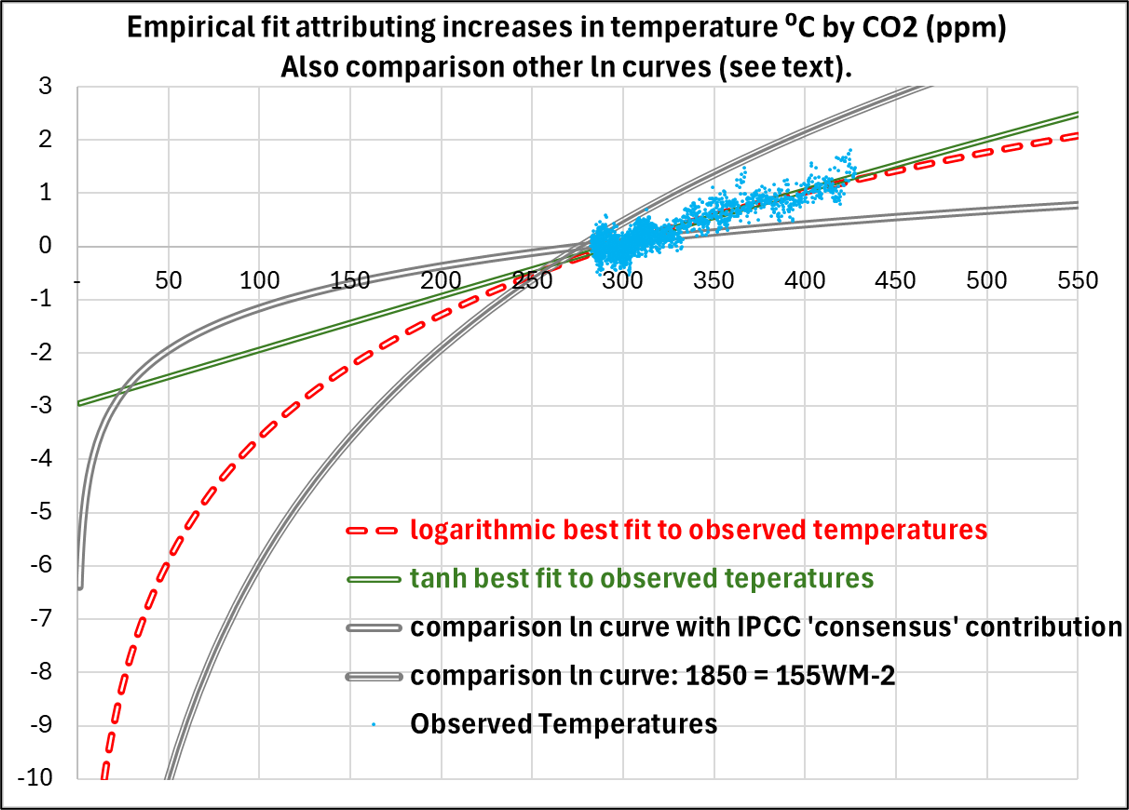
Also shown, for comparison purposes, on the above graph are two further Arrhenius [ln] curves as grey lines .
The grey line ‘Comparison ln curve with IPCC 'consensus' contribution’ is the IPCC’s consensus curve for CO2’s effect on global average temperature (based on WM-2 = 5.35 ln(CO2 ppm)/4.71). This, the theoreticians would say, is the ‘Direct’ Global Warming’ effect.
The other grey line ‘Comparison ln curve: 1850 = 155WM-2’ is a hypothetical Arrhenius [ln] form curve where the total 1850 greenhouse effect (155 WM-2, 33⁰C) is attributed to CO2.
This (‘Comparison ln curve: 1850 = 155WM-2’) relationship projects temperature rises for 'doubling' close to the IPCC’s sensitivity cases that invoke ‘feedbacks’.
A summary of how the contribution to 1850 level of CO2’s greenhouse effect on temperature is calculated by the models as follows:
- 33⁰C : The Arrhenius [ln] fit to the total effect (155 WM-2 = 33⁰C)
- 19⁰C : Best Arrhenius [ln] fit to observed temperatures (blue circles)
- 6.4⁰C: ‘consensus’ IPCC contribution to greenhouse effect (30 WM-2)
- 3⁰C : Best [tanh] fit (14 WM-2)
Dr. Gavin Schmidt (GISS) estimated the contribution of CO2 to the total greenhouse effect ranges from 3⁰C (14 WM-2) to 8.5⁰C (40 WM-2) depending on how much warming from the ‘overlap (with other greenhouse gases) zones' is attributed to CO2.
The Greenhouse Effect discusses this important ‘Overlap and Broadening’ zone in the context of contributions to the total greenhouse effect.
Ussing the Simple Model gave unimpressive (statistically) reductions in variance so a further model was developed.
The Second Model
There was a notable improvement in ‘fit’ in going from the Simple Model to the Second Model for the [ln] relationship. But this improvement was insufficient to push it into the ‘significantly interesting’ zone.
However, the Second Model [tanh]-form showed markedly improved of fit. The explanation of variance increased to 90% pushing it firmly into the ‘interesting’ zone.
This is illustrated in the following graphic.
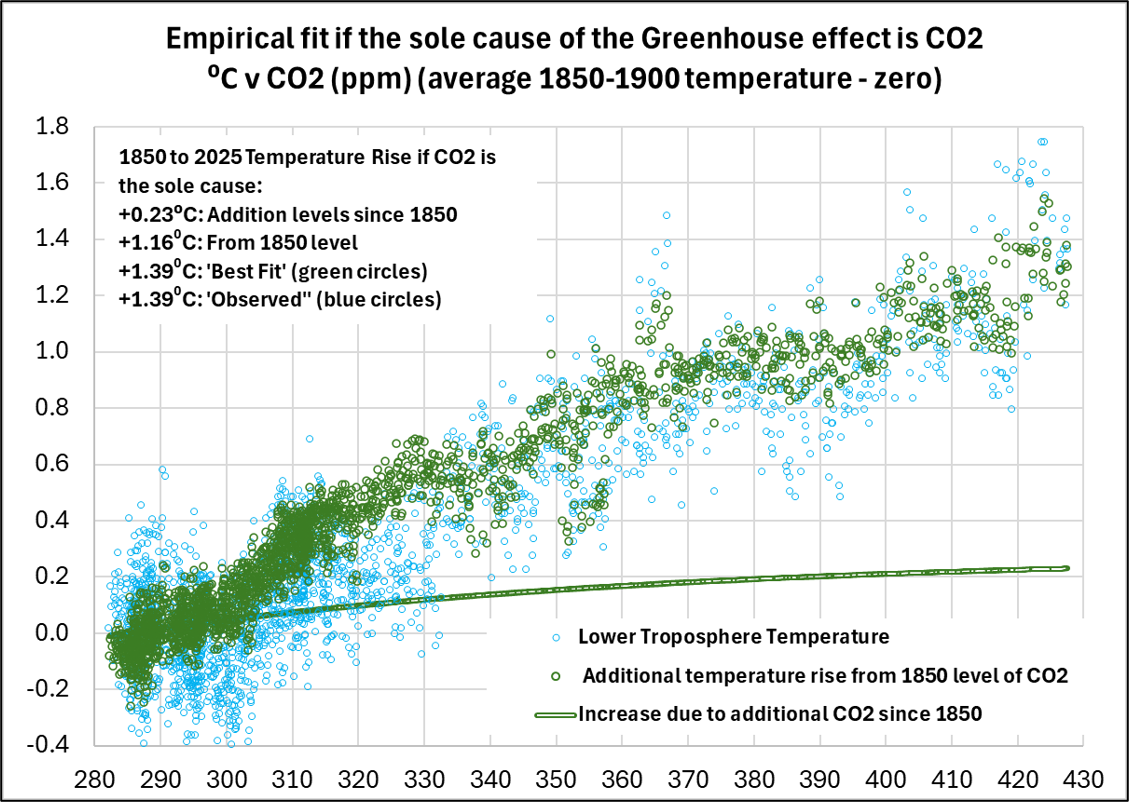
The improvement in the fit is clearly seen in this graph. The blue circles are the observed (anomalous) global average temperatures.
The green circles are total calculated by the [tanh] Second Model.
The contribution to surface temperature from additional atmospheric CO2 is the green-line [tanh].
This case indicates that if CO2 was the sole contributor to the 1850-2025 rise of +1.39⁰C then the increased CO2 levels since 1850 would add ~0.2⁰C (<15%) to the total.
This case was investigated by maximising the contribution from increased CO2 (since 1850) subject to a less than 2% variance loss of ‘fit’.
A better fit was obtained by allowing the contribution from increased CO2 (since 1850) to fall to below 0.1⁰C.
The gap – from the green line to the green circles - is the contribution from the effect of the changing atmospheric temperature profile on the level of CO2 that existed in 1850.
The residuals – i.e. the changes in observed temperature not explained by the Second Model [tanh] fit are shown below (x-axis: time).
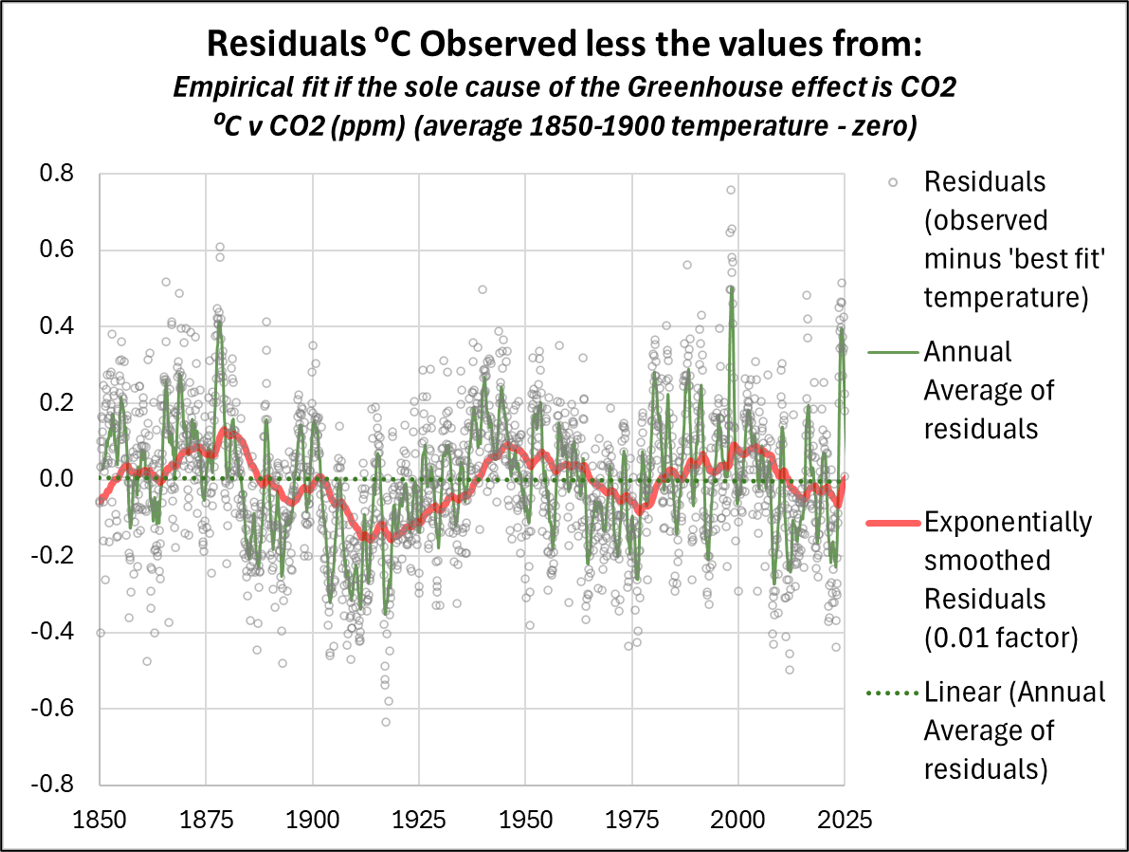
The residuals exhibit no long-term trend.
A long-term-oriented exponentially smoothed plot reveals features which are interesting and further explored in the section ‘Residuals’.
How are these results to be interpreted?
The Climate Change Anointed interpretation would be that ‘of course CO2 is the main cause of Global Warming – would you expect otherwise? It's obvious!’
They would also interpret that the analysis shows that the full +1.39⁰C rise is explained as ‘this shows the ‘feedbacks’ multiplying their ‘Direct Warming’ by a factor of three are also vindicated.’
A more realistic observation would be that the correlation explaining 90% of the variance is ‘interesting’ and strongly indicative that a relationship exists.
However, the strength of correlation falls far short of that required to contribute to a full causal explanation.
One of the more interesting observations is that the [tanh]-form is a much better fit than the Arrhenius [ln] form
It is also interesting to note that of the contributions to the Second Model total, those that are associated with altitude temperature profile far outweigh those associated with increased levels of CO2 since 1850.
This is a further indication that we should question the scientific modelling of the saturation effect.
Although considered as ‘settled’ by Anointed scientists the evidence of this ‘Emissions-Temp Model’ case must raise doubts.
The ‘OTHERS’ Only Case
A similar analysis as carried out on CO2 (above) was carried out on the other greenhouse gases.
The ‘Others’ are, principally CH4, N2O and O3 together with some contributions from industrial pollutants such as sulphur hexafluoride.
Rather than carry out individual analyses for each of these gases, they were combined into a single quasi-concentration profile comparable to CO2.
This was done by multiplying each gas concentration by a ‘power factor’.
These ‘power factors’ are similar, but not the same as GWPs - Global Warming Potentials - commonly used to evaluate ‘CO2 equivalents’.
GWPs measures how much energy 1 ton of a greenhouse gas (GHG) absorbs over a given time, typically 100 years, relative to 1 ton of CO2. Key factors influencing GWP include the gas’s infrared absorption strength, its atmospheric lifetime, and its chemical transformation.
Factors similar to the infrared absorption strength factors that go into GWPs were determined (using the Second Model - by variance minimisation) to be multiple of CO2 as: CH4 13.35 (GWP 28-36), N2O 676 (GWP 265-273) and O3 21.
The lack of homogeneity both geographically and altitudinally make using the factors (applied to global average ground-level concentration) less than ideal.
A small factor related to global population was added to model the effect of industrialisation pollutants such as SF6.
These ‘Others’ cases are based (like the CO2 only case) on investigating the relationship of their increase in concentration to the total warming 1850 to 2025. (+1.39⁰C).
The Arrhenius [ln] and [tanh] fit cases – as described for CO2 – were repeated for the ‘Others’.
The variance reduction outcome was not as good as for the ‘CO2 Only’ cases but was still enugh to push the cases into the 'interesting' category.
A summary of how the contribution to 1850 level of the ‘Others’ on temperature was calculated by the models as follows
- 5.7⁰C (cf. CO2: 19⁰C): best [ln] fit
- 2.6⁰C (cf. CO2: 3⁰C): best [tanh] fit.
-
As with CO2 these cases are based on the Second Model and made a big improvement to the ‘fit’ compared to the Simple Model.
The [tanh] Second Model fit showed a marked improved over the [tanh] Simple Model compared to the improvement for the [ln] model and is illustrated in the following graphic.
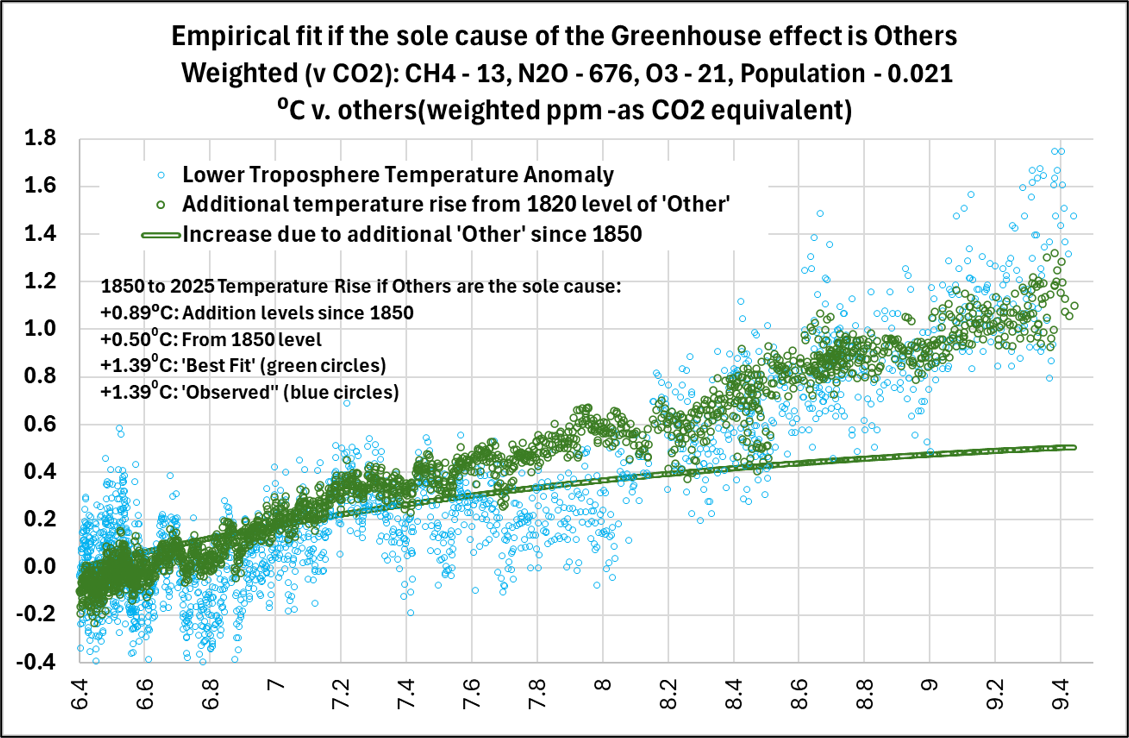
The improved fit is not as clearly seen in this graph as in the similar graph for CO2 only.
The addition to the contribution to temperatures from additional concentrations of ‘Others’ since 1850 is the solid green line [tanh].
This indicates that if the ‘Others’ were the sole contributors to the temperature increase of 1.39⁰C, then the increased levels since 1850 would add ~0.5⁰C to the total (of +1.39⁰C).
Comparing the ‘Others’ curve with the CO2 curves it can be seen that the ‘Others’ [tanh] curve is not as ‘flattened’ as the CO2 [tanh] curve.
This indicates a lower level of saturation is reached for the ‘Others’ in 1850 compared to CO2.
The graphic below charts the residuals (where the x-axis is time)
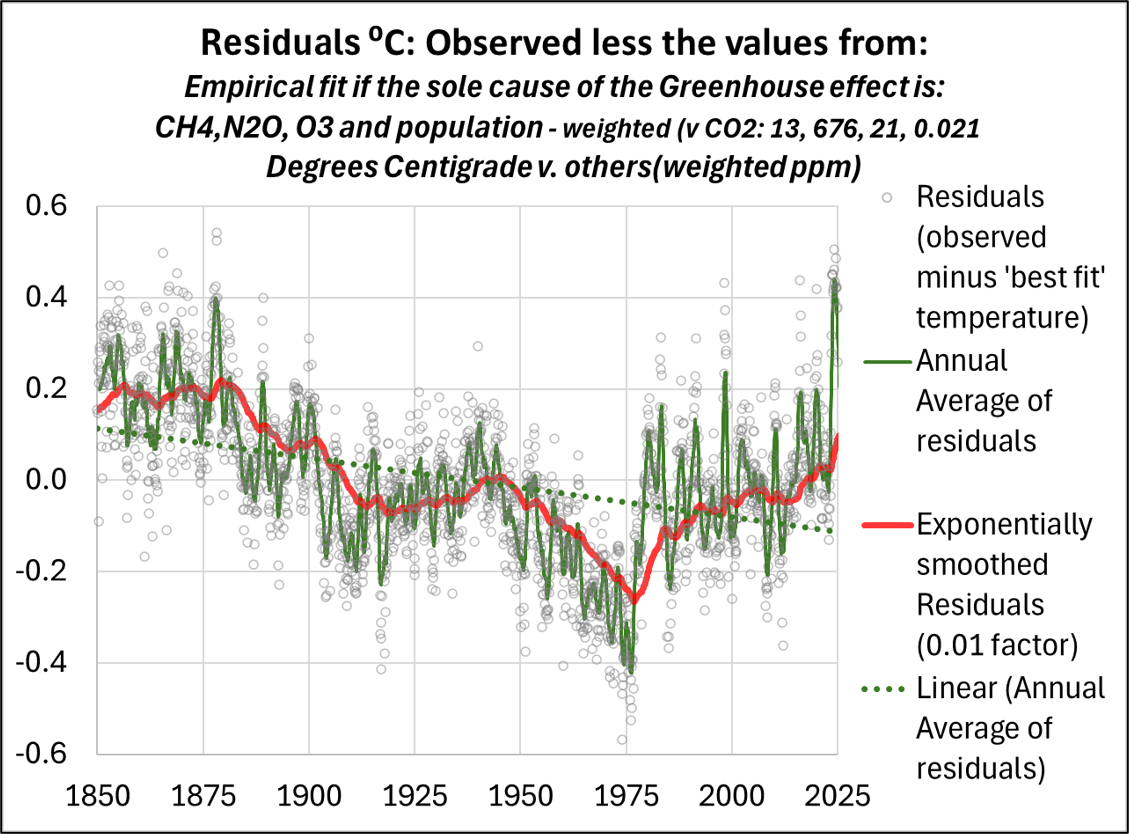
Although ‘Others Only’ is nowhere as good a fit as ‘CO2 Only’, the long-term exponentially smoothed plot of residuals reveals similar features to the CO2 residuals plot.
How are these results to be interpreted?
The Climate Change Anointed interpretation would be that of course ‘Other gases – particularly methane - contribute significantly to Global Warming - isn't it obvious?'
However, to explain why the ‘Others’ almost explains the whole of the 1850 to 2025 rise (+1.39⁰C) is not as easy as for ‘CO2 Only’.
A more realistic observation would be that, as the correlation explaining the variance reduction, is poorer than ‘CO2 only’, the ‘Others Only’ is a less interesting starting point for analysis.
The level of correlation for ‘Others Only’ was not significantly greater than might be found for anything that has increase since pre-industrial times: life expectancy, the proportion of land in agriculture, the value of an 1850 £ or any other increasing statistic.
The ‘Others’ correlation falls very far short of that required to justify causality.
One of the more interesting observations is that the [tanh]-form is a much better fit than the Arrhenius [ln] form.
The ‘Others Only’ [tanh] curve is on a steeper part of the curve than the ‘CO2 Only’ curve.
This indicates that 'the levelling-out as saturation increases' effect is on a steeper part of the curve than for CO2.
The ‘CO2-equivalent’ concentrations for the 'Others' run from 6.4 to 9.3 ppm compared to 285 to 426 ppm for CO2.
This is a further indication that perhaps the saturation effect empirically follows a [tanh] form rather than the Arrhenius [ln] form.
Further evidence to re-think the theoretical Arrhenius [ln] form that has never been verified by observation or experiment.
Water Only Case
Like the ‘CO2 Only’ and ‘Others Only’ cases, the possible empirical correlation of water to the whole of the 1850 to 2025 temperature rise was investigated.
Water is much harder to model than CO2 or other trace greenhouse gases.
Present in the atmosphere at an average concentration of ~9,000ppm it is very unevenly distributed geographically and may be as much as 40,000ppm in the humid tropics but almost negligible over dry, cold deserts.
Even a clear-sky estimate of water vapour content is difficult to make.
Water also forms clouds that trap a greater amount of heat than a clear skies humid atmosphere. But clouds also reflect more sunlight back into space. As discussed in pages ‘The Greenhouse Effect’ the implication of water on the total greenhouse effect is difficult.
The implications for global average surface temperature are even more difficult.
The altitudinal concentration of water vapour is very different to CO2.
The concentration varies rapidly through cloud- formation layers and tails off as the Stratosphere is approached.
CO2 concentrations up to the stratosphere and beyond are nearly constant although the abundance of CO2 molecules falls off with altitude as pressure falls.
Evidence from the Cardinal model indicates that the ‘concentration’ of water representing clear-skies humidity and/or cloud cover shows a gentle long-term increase – at least since 1979.
In ppm terms , extending this trend to the 1850 to 2025 period is equivalent to adding between 150 to 350 ppm in clear-skies humidity terms. In cloud-cover terms it is between 1 and 4%.
As it is impossible to isolate the greenhouse effect of water on either a clear-skies effect or a cloud cover effect, an index (from 0 to 100) is used, below, to graphically represents the effects of variations.
Changes in altitudinal temperature profile also impact the greenhouse effect of water in a similar manner as noted above for CO2 and the others, so the Second Model most accurately represents the real situation.
Clearly an Arrhenius [ln] form is inappropriate for water as its infrared absorption must have already (at 9,000ppm) reached the highly saturated flattened section of the [tanh] curve.
This means that the main effect on the greenhouse heat absorption (by clouds and extra atmospheric concentrations) must be due to the impact of the atmospheric temperature profile on the very large concentration of water present in 1850.
Testing if water could be the only contributor to Global Warming the best Second Model [tanh] curve fit estimates the 1850 level of water contribution at 35⁰C (165 WM-2).
This is only slightly greater than the accepted total greenhouse effect (1850) of 33⁰C.
The graph below illustrates this ‘all due to water’ case.
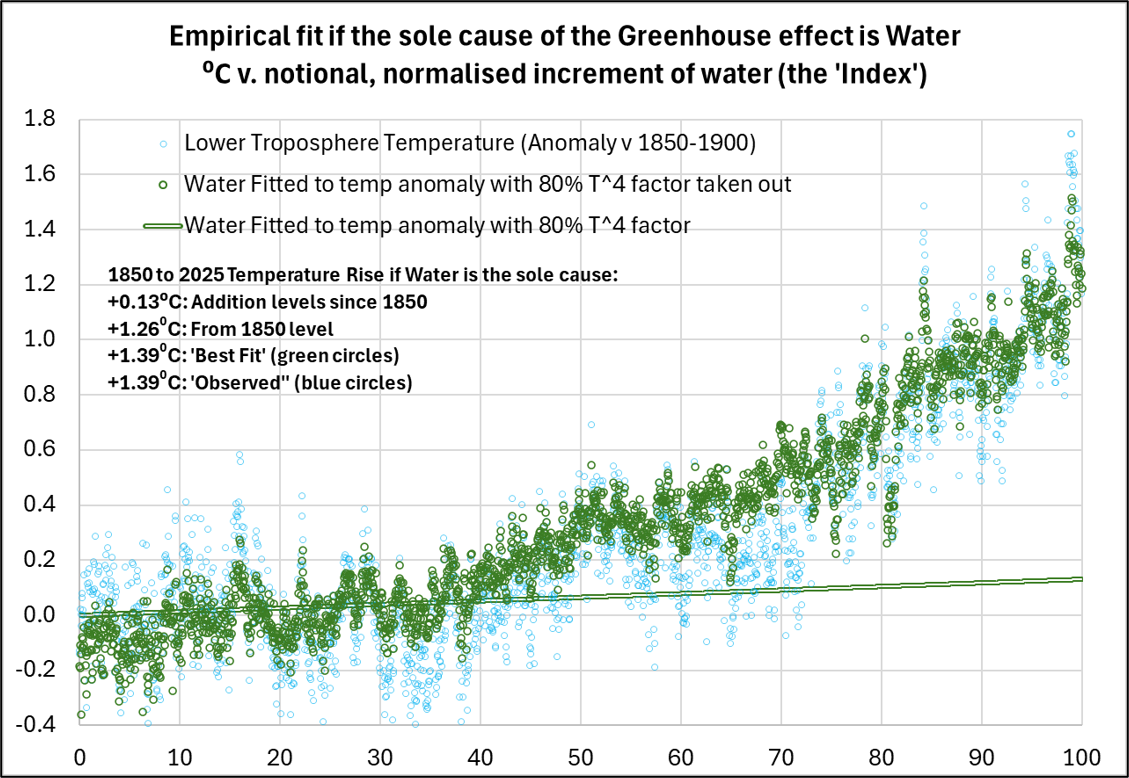
This ‘Only water’ case is a marginally better fit than even ‘CO2 Only’.
How are these results to be interpreted?
Some expert climate commentators maintain that water is, by far, the most important factor affecting climate. They cite the impact of water being the main greenhouse gas, the complexity of clouds and the massive transport of heat around the Earth by water as justification for this comment.
They would also agree that theoretical modelling of these very complex phenomena is ‘too difficult’.
Modelling the greenhouse effect of water is challenging enough but modelling the link to the Earth's surface temperature is 'far too difficult'.
These experts might also find the empirically derived graphic, above, unsurprising.
Any empirical investigation into linking water and surface temperature would be expected to find that a strong relationship exists.
A Climate Change Anointed interpretation might be that this is evidence that the alleged ‘feedbacks’ mechanism for CO2-warming is related to water.
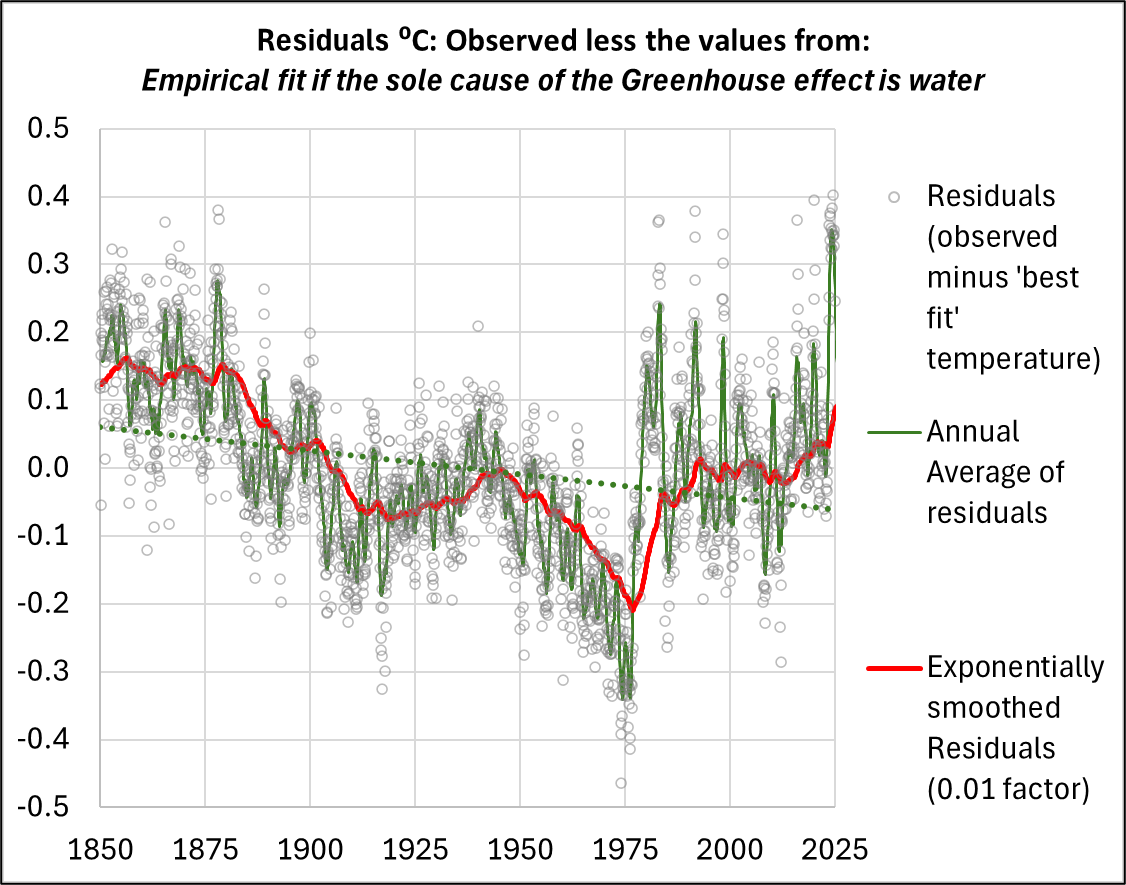
The residuals plot from the best [tanh] fit for water shows similar characteristics to CO2 an the ‘Others’.
CO2, 'OTHERS 'and Water - Combined
Dr. Gavin Schmidt and colleagues at NASA GISS commenting on climate sensitivity and forcing (greenhouse gas caused warming), pointed out that there is much spectral and physical overlap between different greenhouse gases (GHGs), aerosols and clouds.
An ‘Advancing Earth and Space Sciences’ publication explains this ‘climate expert’ view.
The Overlap Problem:
Water vapor, CO2, and clouds absorb radiation in overlapping spectral bands. If one calculates the impact of CO2, water vapor, and clouds individually without accounting for these overlaps, the sum of their individual effects will greatly exceed the actual, observed total greenhouse effect.
Significance:
By explicitly accounting for these overlaps, researchers can narrow the uncertainty range of climate forcing (radiative absorption), demonstrating that the individual forcings are lower when "shared" absorption is calculated correctly.
While NASA GISS are firmly members of the Climate Change Anointed, their observations are relevant here.
In this present study, it is clear that adding the ‘Only’ cases for Water, CO2 and ‘Others’ does not give a valid picture as it would explain a total 1850 to 2025 temperature rise of +4.17⁰C (three times the observed value).
The individual ‘Only’ models could be combined with relevant weighting factors. This approach that was rejected as it does not lead to a better ‘fit’.
A ‘variance-explaining’ combination approach was adopted by setting up different ‘scenarios’.
How much water, how much CO2 and how much ‘Others’ to include in a scenario?
A series of scenarios were constructed for different combinations of water, CO2 and Others.
These combination scenarios were subject to the same variance minimisation procedure as for the three ‘Only’ studies.
The total contribution to 1850 warming was constrained to a maximum of 33⁰C and encouraged to get as close as possible to this total.
A further incentive was given to the variance-reduction algorithm to get as close as possible to the observed 1850 to 2025 increase of +1.39⁰C.
Several case and scenarios were investigated.
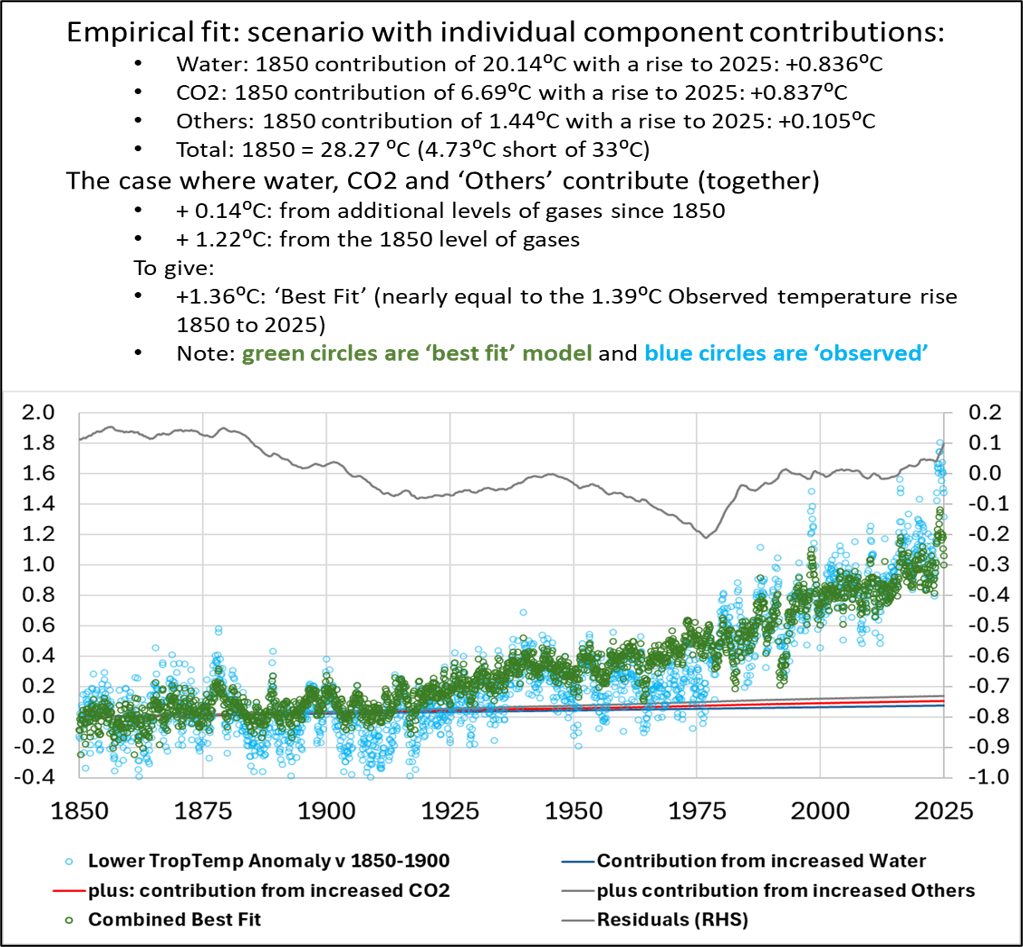
The scenario, illustrated below constrained individual contributions to:
- Water: 1850 to a maximum of 23.78⁰C & unconstrained contribution to rise to 2025
- CO2: 1850 to a maximum of 7.43⁰C & unconstrained contribution to rise to 2025
- Others: 1850 to a maximum of 1.70⁰C & unconstrained contribution to rise to 2025
Maximum variance minimisation was achieved by a case where the total 1850 contribution was 28.3⁰C (a bit short of 33⁰C) and the total rise from 1850 to 2025 of +1.36⁰C (slightly short of +1.39⁰C).
For this scenario, the following graphic illustrates how the contributions to the total build up.
Showing this case a different way:
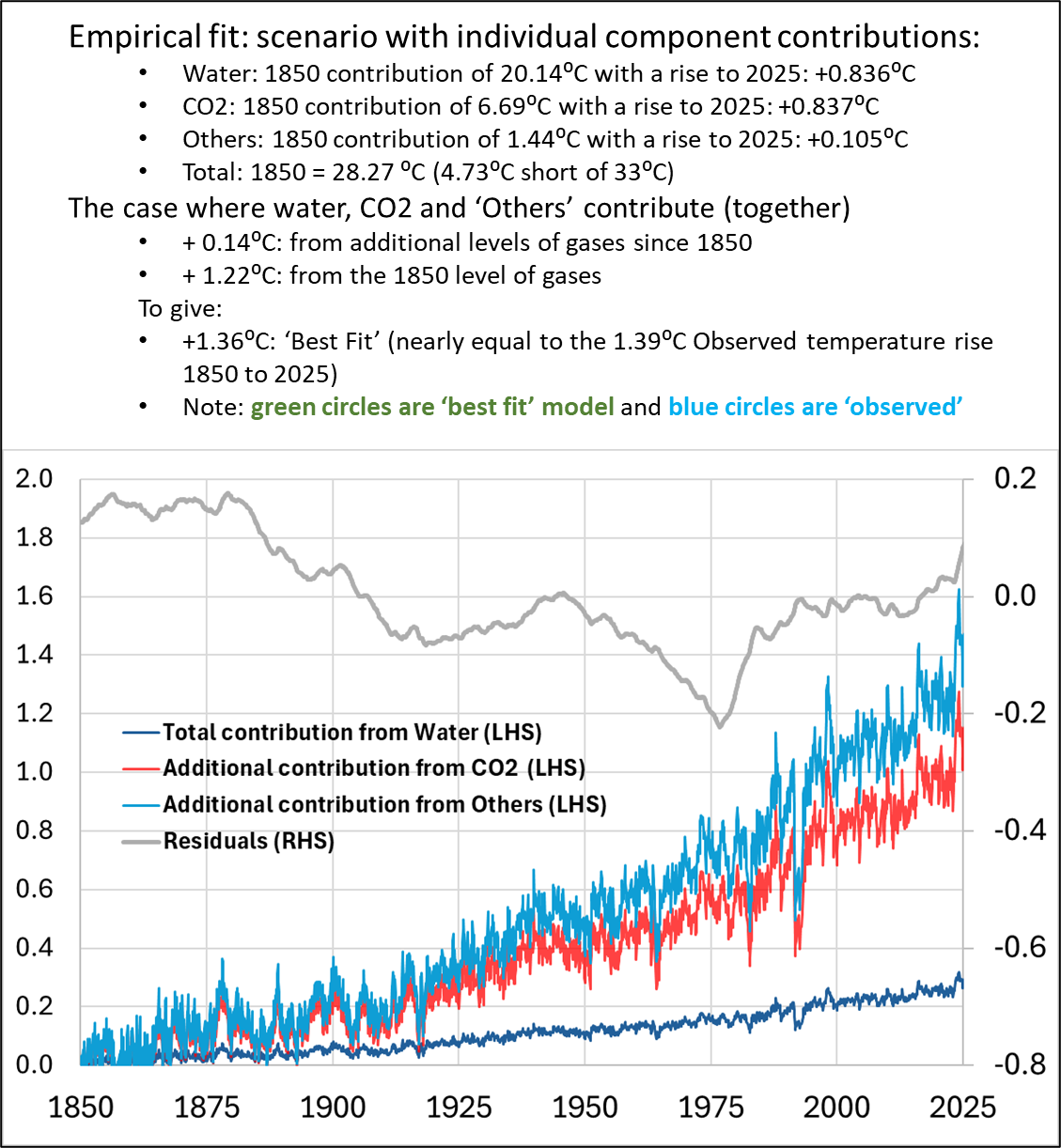
This combined case explains even more variance reduction than any of the ‘Only’ cases.
This shows a combined model may be more representative of what’s actually going on.
Nevertheless, the ‘best fit’ is not good enough to validate any causal assertions one way or the other.
Clearly a lot of ‘other stuff’ must be going on.
The residuals plot from the ‘best [tanh] fit’ for the combined case shows similar characteristics to the residuals from the ‘only’ cases.
How are these results to be interpreted?
Perhaps the most significant result from this analysis is how little contribution to the +1.36⁰C is identified as coming from increased levels of greenhouse gases since 1850.
Various cases were run testing the sensitivity of this ‘best fit’ case but confirmed that the goodness of fit deteriorated if the coming from increased levels of greenhouse gases since 1850 was forced to be greater.
The superiority of the [tanh] form as the ‘best fit’ reassures us that further increases of concentrations of CO2, CH4, N2O and O3 will have a minimal – near negligible – effect on surface temperature.
The panic, anxiety and economically ruinous actions and policies that have followed the hysterical alarm calls of ‘Climate Change’ zealots are unfounded.
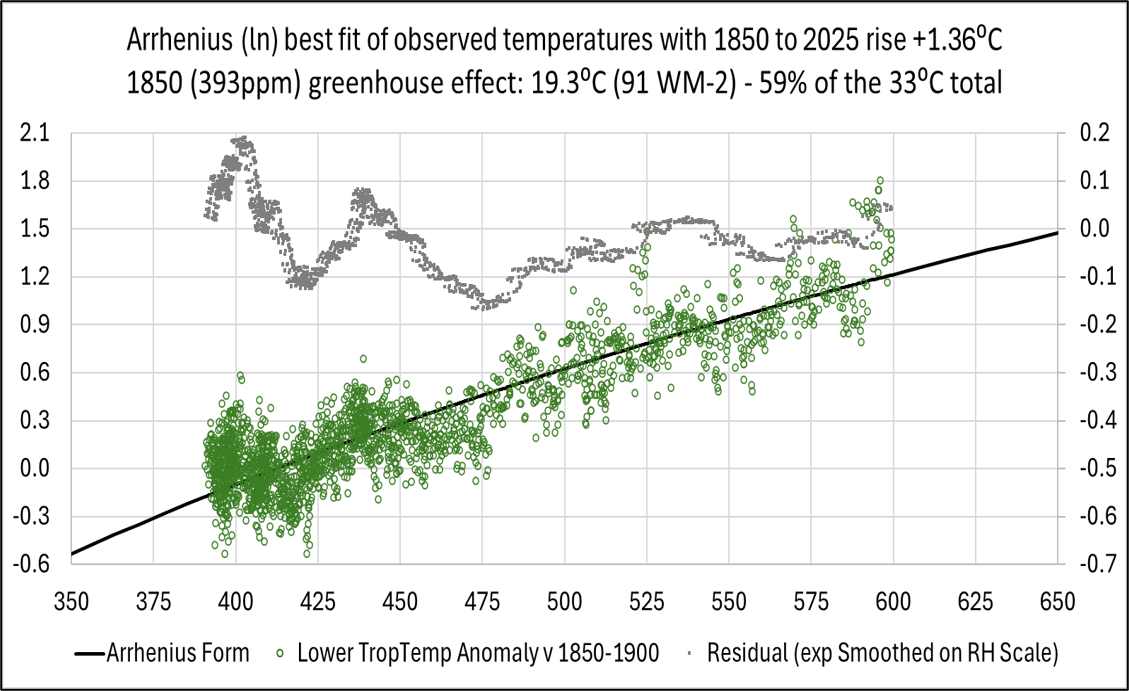
An Arrhenius 'Best' Fit - for comparison
For comparison purposes, an Arrhenius ‘Best fit’ was constructed.
While such a fit is should principally be of academic interest only, it is noted that this is the form of relationship built into the Climate Models used to predict various futures including ‘Runaway Global Warming’.
This Arrhenius [ln] model was constrained to give an 1850 to 2025 temperatures rise of 1.36⁰C – the same as the Combined model above illustrated above.
The [ln] model used a ‘CO2 equivalent’ basis combining CO2, CH4, N2O and O3 according to their Global Warming Potentials (GWPs).
This ‘best fit’ approach implies built-in ‘sensitivity’ multiplier of nearly three.
The model was unconstrained on the level of 1850 greenhouse effect and resulted in the ‘best fit’ being achieved with the 1850 level at 19.3⁰C - only 59% of the generally accepted total in 1850 of 33⁰C.
The best fit achieved a variance reduction of 78% - far short of the level of fit from Second Model [tanh]-fit reductions of 90% achieved above.
This level of fit barely gets it into the ‘statistically interesting’ zone.
Nevertheless, it is included here for three reasons:
- It is the type of relationship included in climate models, and
- The ‘doubling’ to 2.1⁰C is less than the IPCC ‘sensitivity’ range
- It is interesting to look at the profile of the residuals
The profile of the residuals is similar, but substantially different, to that seen in other [tanh]-fit models.