Satellite Era Data (since 1980)
Average monthly temperatures are reported monthly on website link https://www.drroyspencer.com/latest-global-temperatures/.
These temperatures are derived from satellite data by the University of Alabama’s Dr Roy Spencer and Alabama’s state climatologist (retired) John Christy.
The satellite programme began in late 1979. 1980 was the first complete year.
The data covers different atmospheric layers (Lower Troposphere, Mid-Troposphere, Tropopause and Lower Stratosphere.
As explained by Dr Spencer: "satellite measurements are not calibrated in any way with the global surface-based thermometer records of temperature. They instead use their own on-board precision redundant platinum resistance thermometers (PRTs) calibrated to a laboratory reference standard before launch, embedded in high-emissivity targets that are viewed by the radiometer once each scan. The radiometers also view the cosmic background radiation (assumed to be 2.7 Kelvin) once each scan. The Earth-viewing measurements are then interpolated between the cosmic background temperature and the warm calibration target temperature.
Earth-based thermometer temperature problems stem from environmental biases and sparse geographical coverage. Most land-based thermometers are located in areas influenced by the urban heat-island effect and inconsistency in measurement (such as the volume of the meteorological box). The consistency and accuracy of ocean based thermometers (70% of the Earth's surface) are different but also require 'adjustment'. All surface-based global average temperature data are, therefore, subject to interpretation. There have been historical cases of the values being 'adjusted' to fit the required narrative - usually one where 'Global Warming is accelating dangerously' or 'the Medieval Warm Period never happened'.
All temperatures are reported as anomalous data against the average for 1991 to 2020.
Data graphs are included, below, for both Historic (1980-2025) and recent satellite measurements (from 2020) for each of the following:
Lower Troposphere - the most often quoted temperature
The Lower Troposphere (global) data is a comprehensively measured metric used for the temperature at the Earth’s surface.
The data breaks monthly averages into different regions but the most often quoted statistic is 'Average Global Temperature' which is the acccumulation of many regional data into a Global average.
The graph, below, shows monthly and average data up to the end of 2025. The average data incorporates some estimates pre-dating the start of the satellite era going back to 1958.
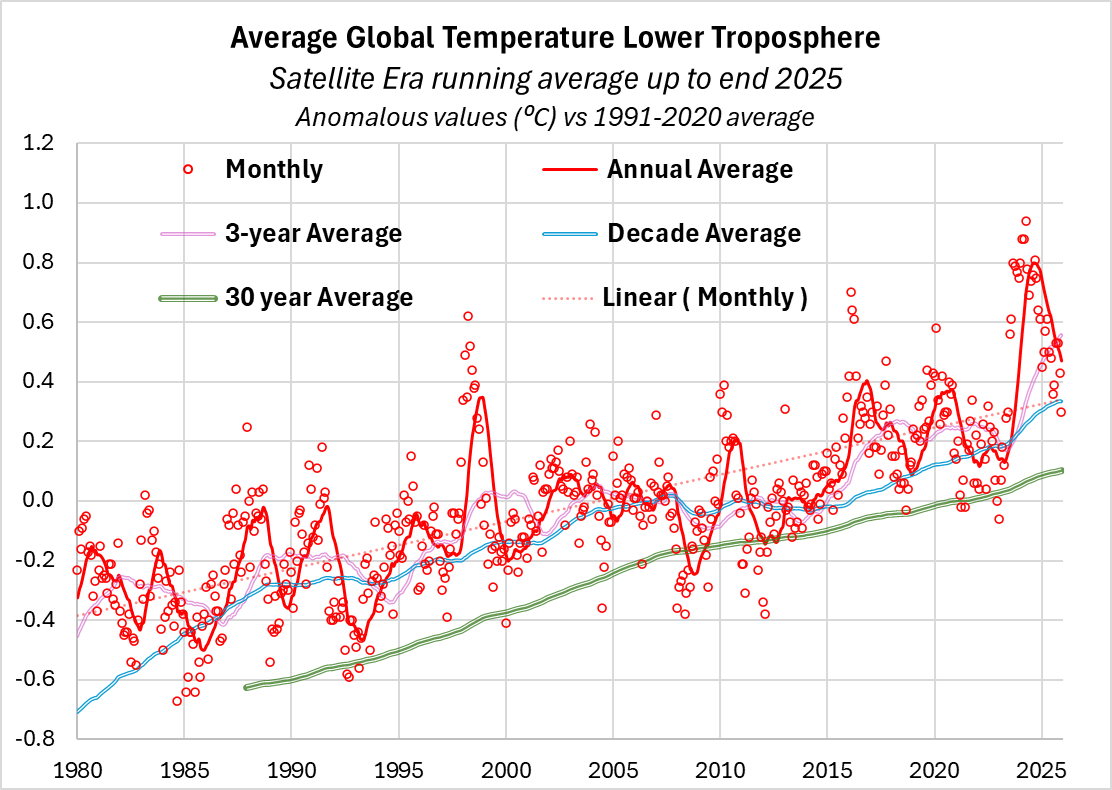
The monthly data is highly variable with a linear trend of +0.158 ⁰C per decade.
The variability smooths out as the period of the average extends from one year, 3-years, decadal and 30-years.
Considering the decadal averages, the line was on an upward trend until the decade 1998 to 2007. From that decade until the decade 2007 to 2016 the decadal average was flat. This means that from the late 1990s until 2016 temperatures showed no decadal-long trend.
Long-term Trends: Lower Troposphere
The best fit (by variance minimisation) to these monthly data yield a highly smoothed temperature profile.
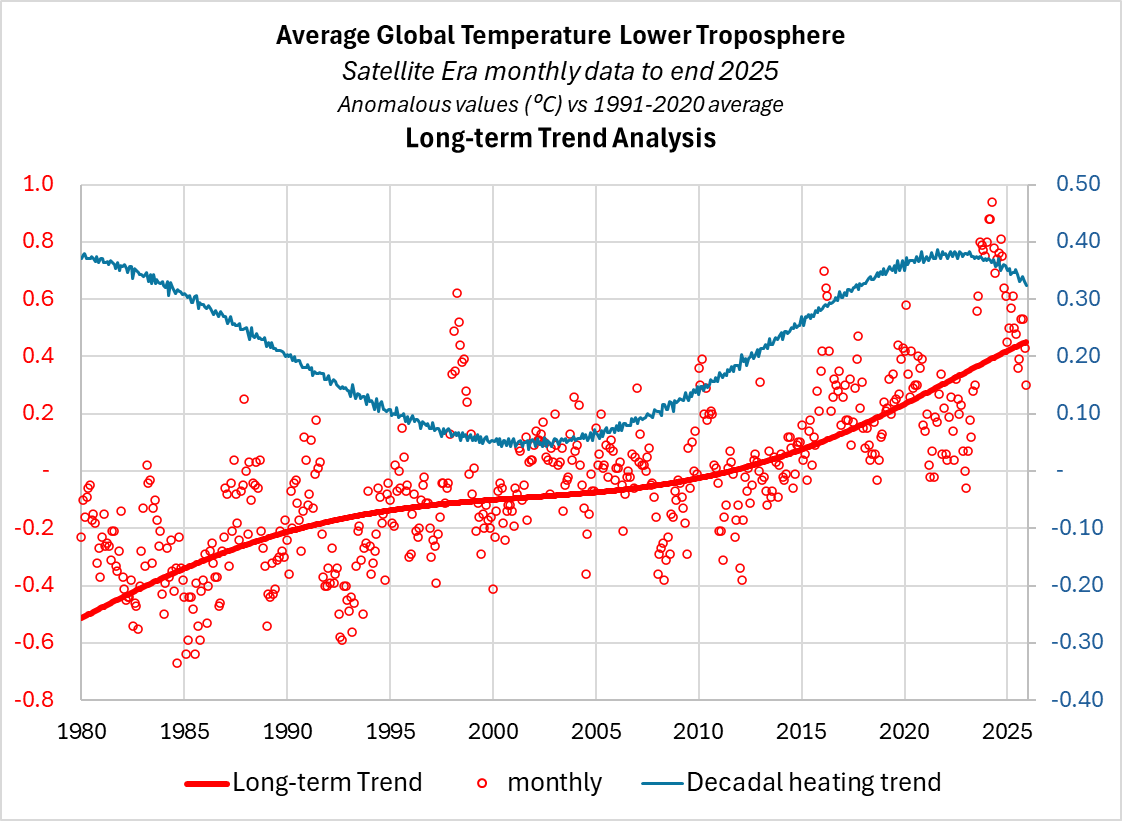
The solid red line is the smoothed ‘best-fit’ long trend while the blue line is an estimate of the decadal warming tend.
This starts out showing the in mid-1970s /1980, decadal warming was as much as 0.4 ⁰C but fell to near zero in the late 1990s/early 2000s.
The rate of warming picked up from 2010 to nearly 0.4 ⁰C per decade but, despite the temperature spike to April 2024, it is trending down for over a year.
How are Lower Troposphere annual and decadal averages changing over 12 months?
There are often comments that a year has been 'the hottest on reccord' or the 'second hottest year ever'
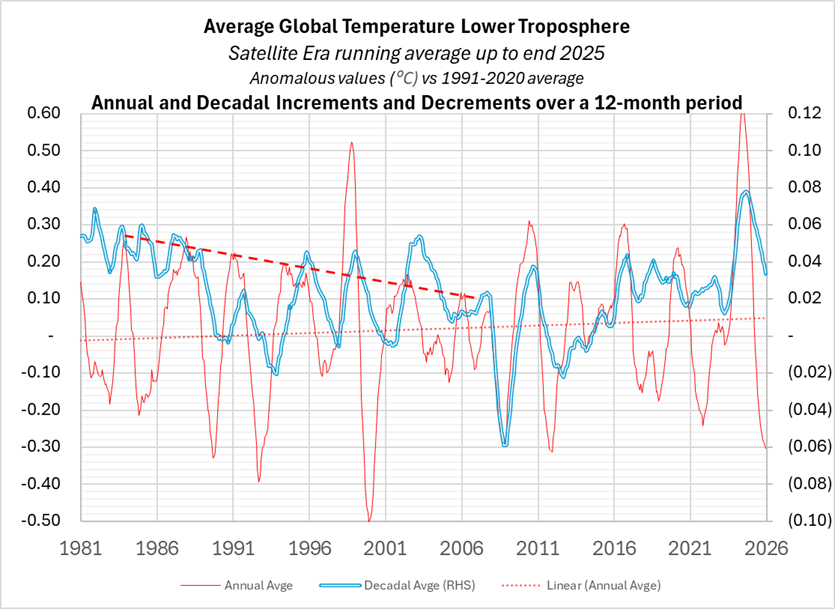
It is more interesting to see how the annual average difference trend month-by-month.
The graph below shows that the 12-month difference between annual averages has twice, in the last 30 years shot up to +0.5 to +0.6⁰C.
The first was to around the hot month of April 1998 (+0.62⁰C) as the Kyoto Protocol was under discussion and the second to the recent record-breaking April 2024 (+0.94⁰C).
The 1998 peak year was an exception in what for the 27-year period (1981 to 2008) a period of falling 12-month difference peaks. It was followed the sharpest cooling (over 12-months) event in the last 45 years.
Most recently the rise to April 2024 elicited alarming comments from world leaders including the General Secretary of the UN (Guterres) warning about ‘Boiling seas'.
For over a year the 12-month difference in annual average has been on a falling trend
Where the current sharp-fall will end is anybody’s guess. Whether it will falll by 1.0⁰C to -0.4⁰C - the same fall as the 1998 peak (which fell from +0.5⁰C to -0.5⁰C) is uncertain. It has already fallen by 0.9⁰C but the fall is showing signs of tail-off.
Decadal rises and falls (plotted of the Right Hand Scale) tend say more about the modern warm period than is evident in annual averages.
Lower Troposphere Since 2020
The graph of differnt period averages (annual, 3-year, decade and 30-year) is expanded for the six years 2020 to 2025.
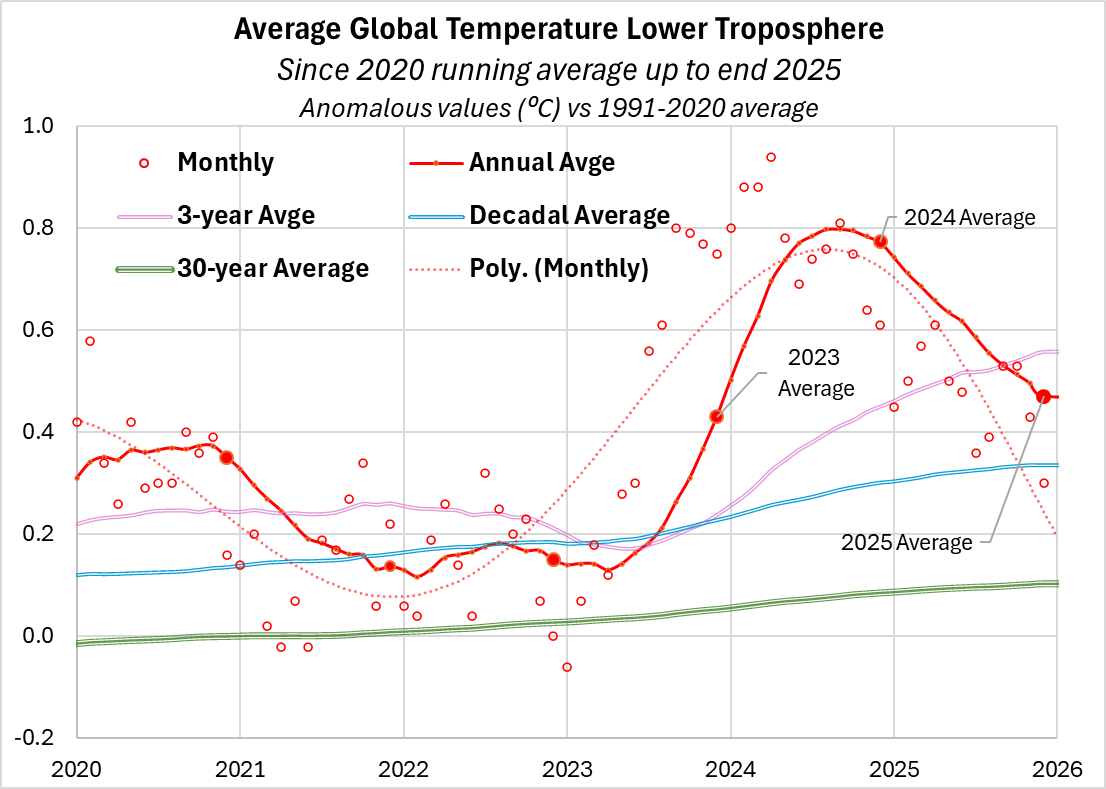
A 'best fit' line is added for the monthly data although it is a poor fit (R-suared 0.73).
The specific years 2023, 2024 and 2025 are noted showing that 2023 was on the way up to the exceptionally hot year of 2024 while 2025 is on the way down.
There is still no cogent explanation for the blip up that peaked around 1.5 to 1.6 ⁰C above pre-industrial temperatures.
Clearly, elevated carbon dioxide (since pre-industrial times) is not even a contributing factor explaining the blip.as the seasonality of its concentration was well within 'normal expectated variations''
Some possible explanations may include the longer-term effect of the Hunga Tonga 2022 eruption which was very different to most volcanic eruptions and thre huge amounts of water into the Lower Stratosphere affected the Greenhouse absorbtion / emission of water and the associated variation in ozone.
Other natural factors may include ocean current variation (particularly ENSO and AMOC) and unseasonally reduced cloud allowing more sun's heat through to the surface.
The annual, decadal and 30-year averages all show a slowing-down or dropping off trend. The exception is the three-year running average which shown an upward trend. For alarmist purposes, the three year average profile is the only one that indicates a strong warming trend. This may explain why some EU agency commentators are choosing to major on the three-year average.
How are recent Lower Troposphere annual and decadal averages changing over 12 months?
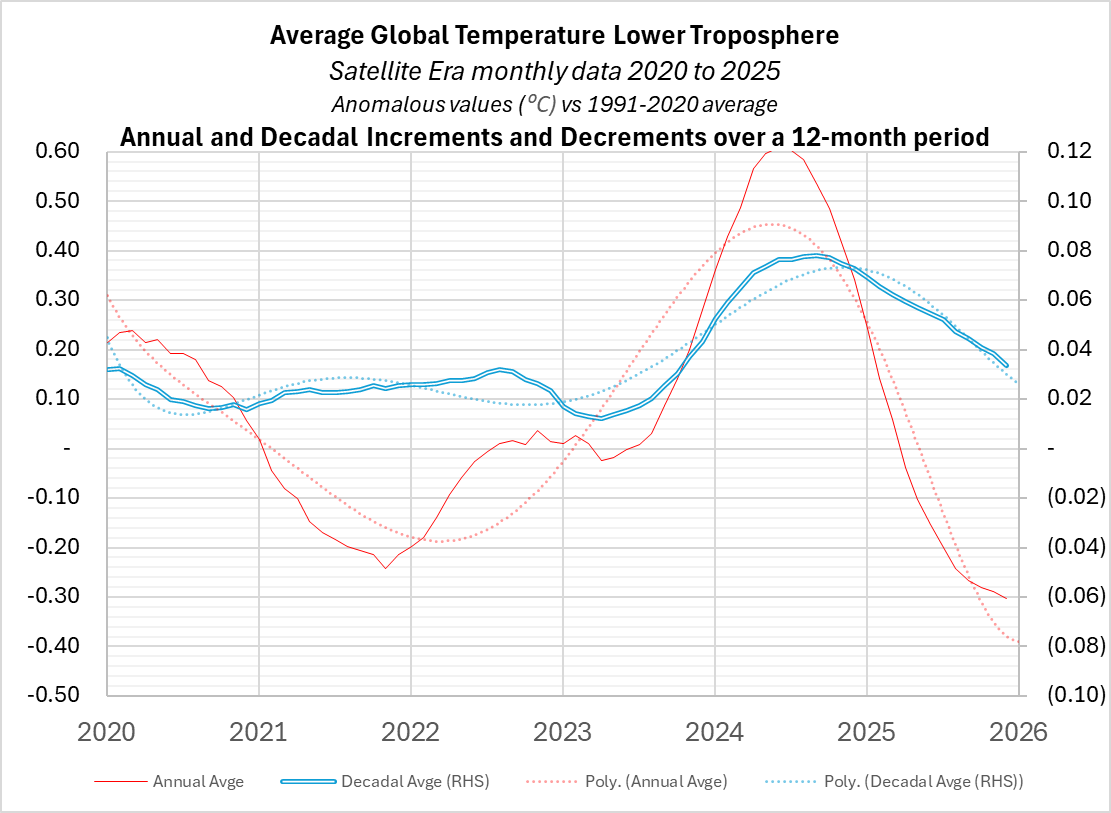
The 2020-25 more detailed graph adds very little to the picture. Once again, it shows that the cooling versus one year earlier may be tailing off - but when is anyone's guess.
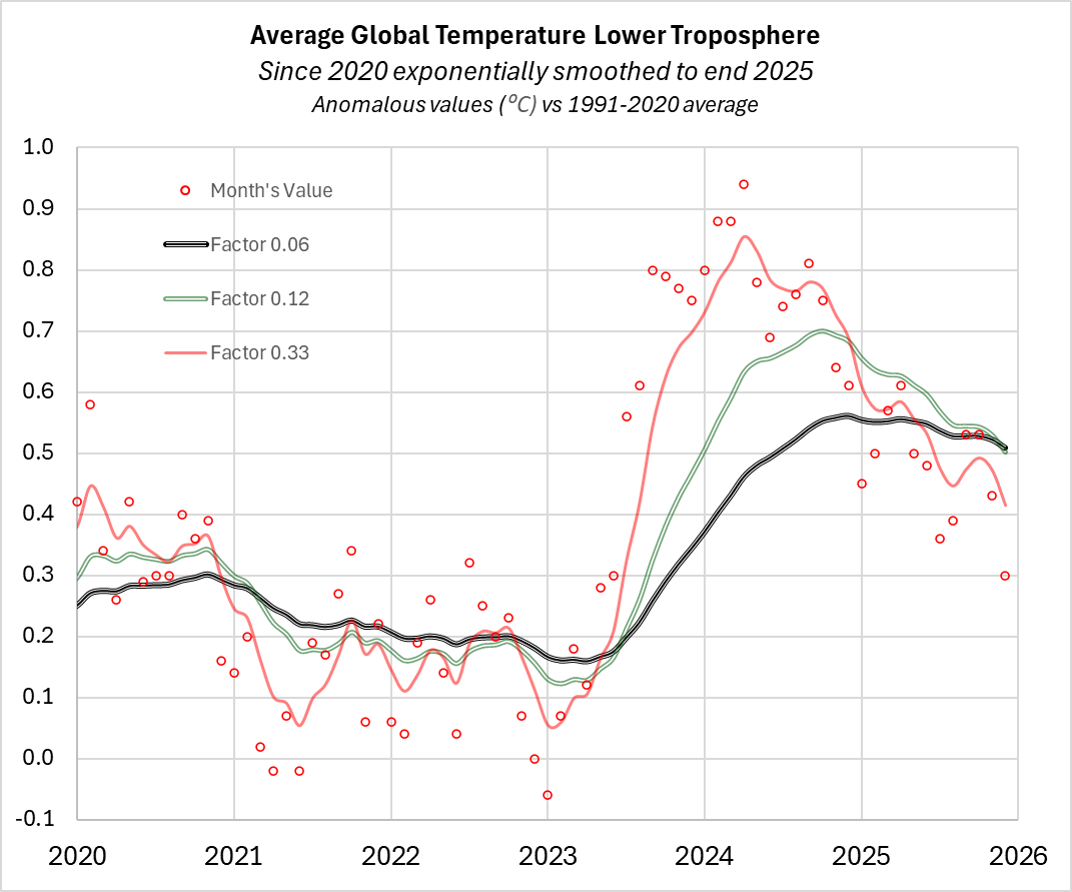
Simple Exponential Smoothed: receent Lower Troposphere
Simple exponential smoothing is a technique to eliminate noise from graphs. A factor is used to determine how much weight is given to recent measurements. The example below shows monthly values and a series of smoother graphs with factors 0.33, 0.12 and 0.06.
All of these smoothed graphs indicate temperatures are currently on a cooling trend. The big question is how long the cooling trend will continue and to what level it will go.
Mid Troposphere - best estimate of the average temperature of the whole atmosphere & the direct effect of Greenhouse warming/cooling
The Mid Troposphere (global) data is a comprehensively measured metric used for the temperature in the mid-Troposphere. If there is a measure of the average temperature (anomalies) for the whole atmosphere this may be as close as possible of the reported metrics.
The data breaks monthly averages into different regions but the most often quoted statistic is 'Average Global Temperature' which is the acccumulation of many regional data into a Global average.
The graph, below, shows monthly and average data up to the end of 2025. The average data lines start where data is available as no reliable mid-Troposphere data was available in pre-satellite times.
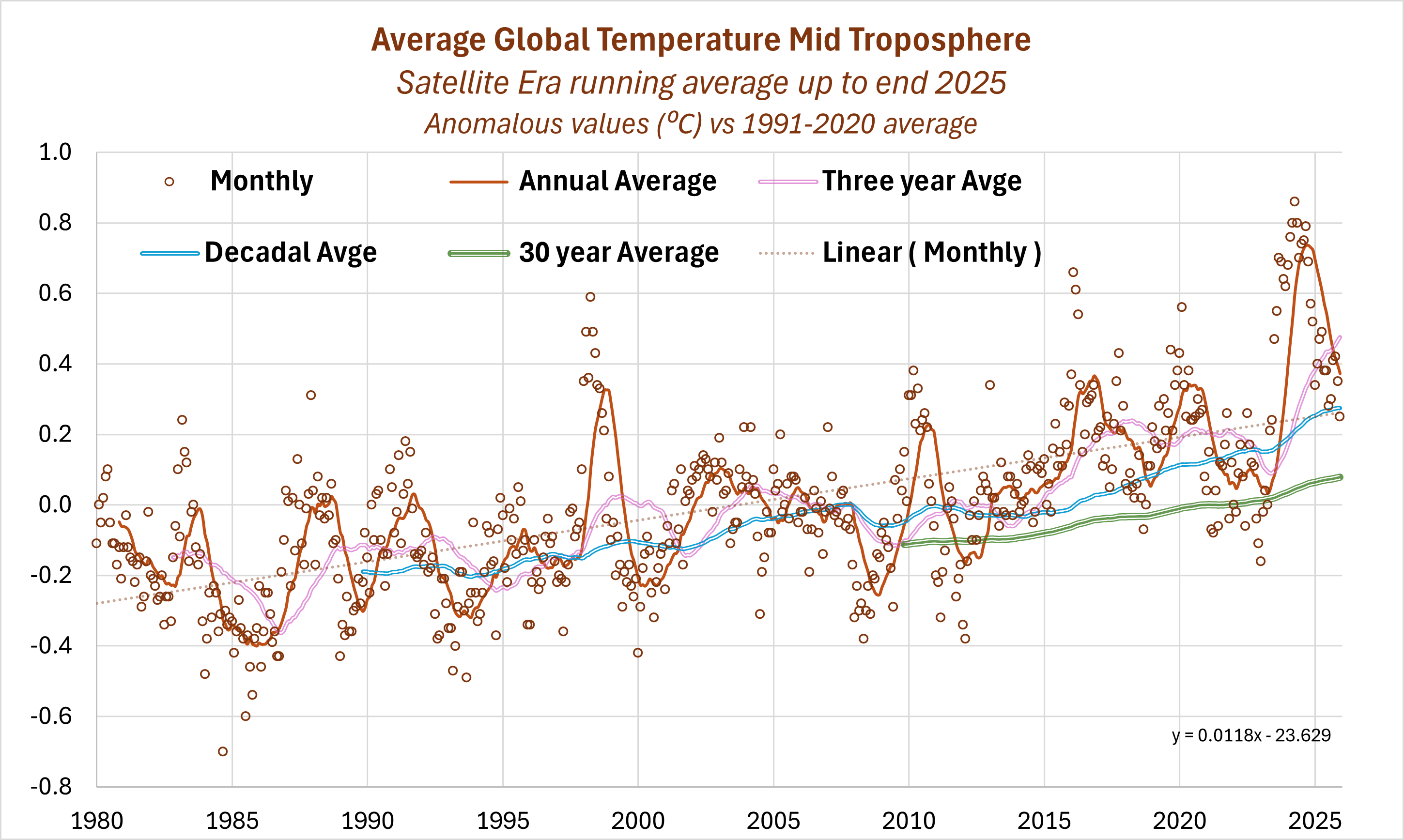
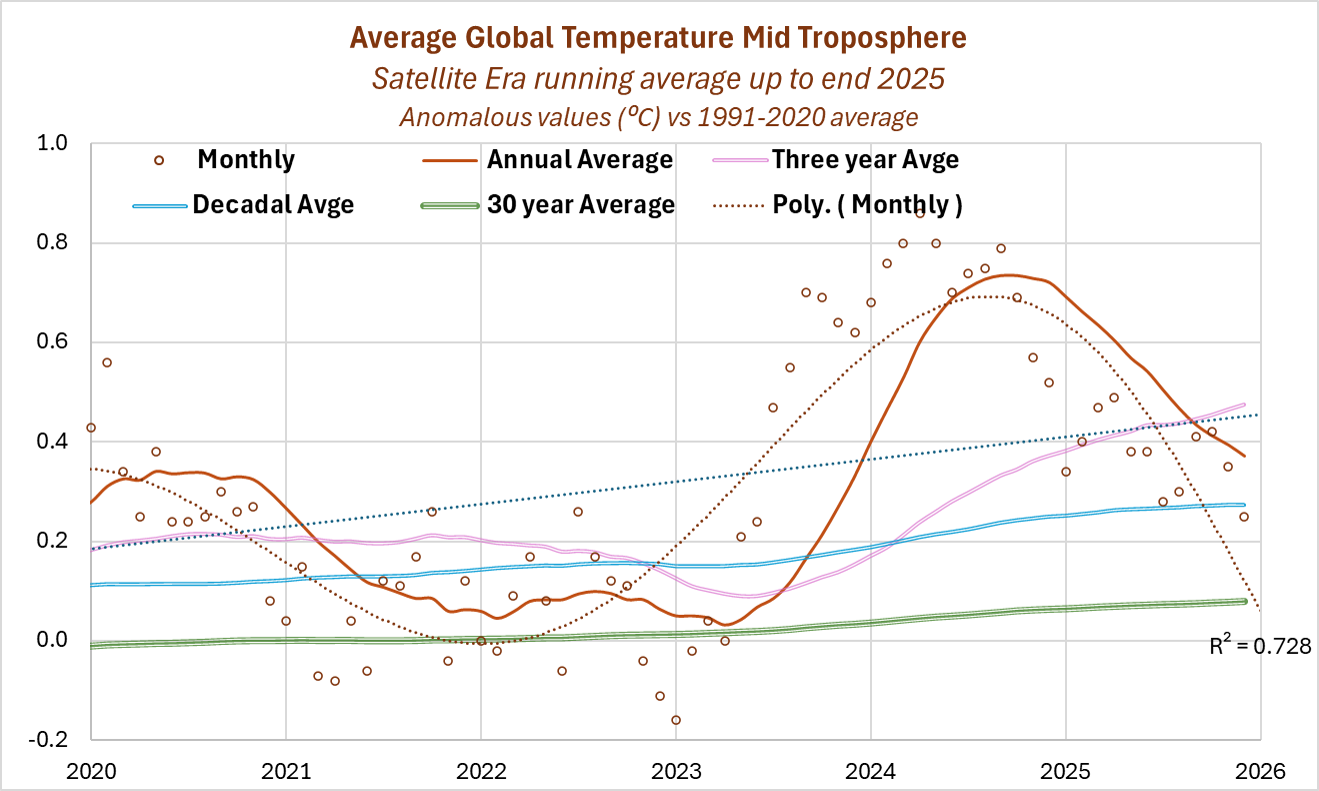
The monthly data is highly variable with a linear trend of +0.118 ⁰C per decade.
The mid-Troposphere plot is similar in form to the Lower Troposphere plot. The variability is not as extreme and the decadal average heating rate is 25% less than the Lower Troposphere.
The variability smooths out as the period of the average extends from one year, 3-years, decadal and 30-years.
The 3-year average line was on an upward trend until 1998. Until 2015 (18 years) the 3-year average was essentially flat. During that period CO2 increased 37ppm (an increase of over 10%) which according to the models of the Anointed calculate the augmentation of Greeenhouse effect should have raised global average mid-Troposphere by between 0.5 and 1.6⁰C.
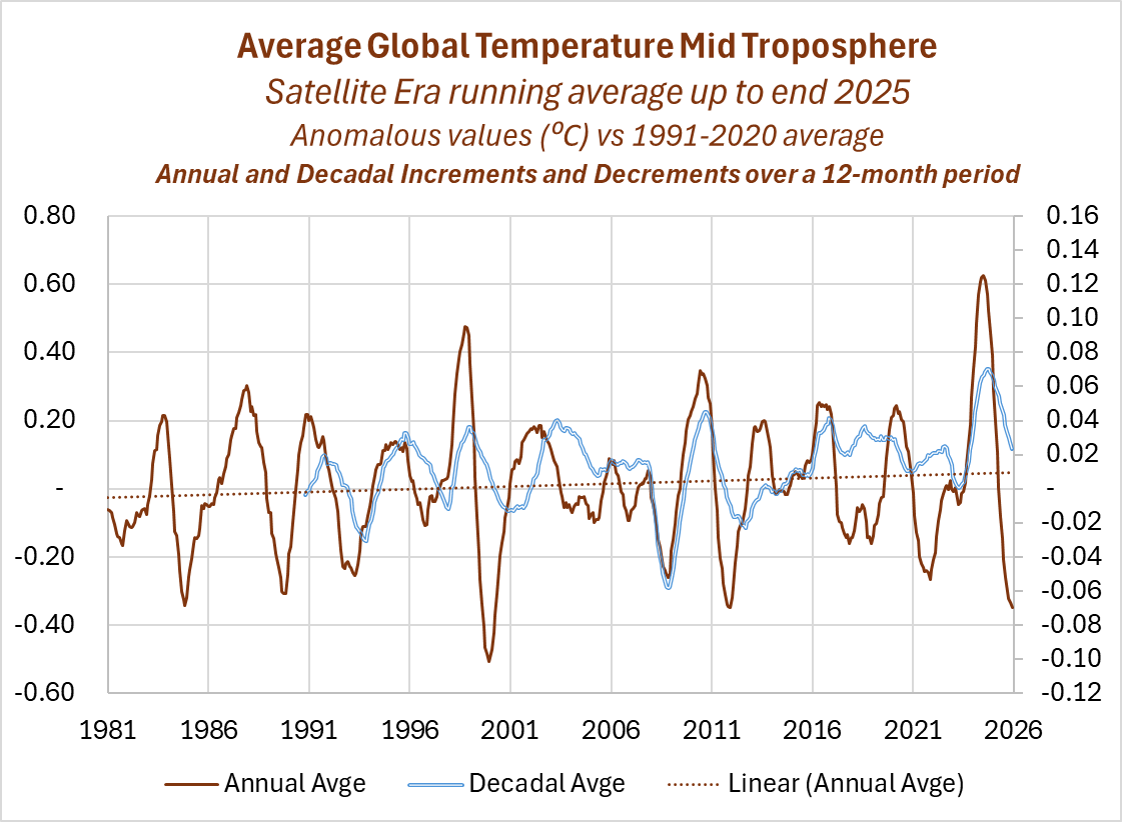
How are Mid-Troposphere annual and decadal averages changing over 12 months?
It is interesting to see how the annual average difference trend month-by-month and how it ccompares to a similar graph for the Lower Trroposphere.
The graph below shows that the 12-month difference between annual averages has twice, in the last 30 years shot up - like the Lower Troposphere.
The first was to around the hot month of April 1998 (+0.59⁰C) as the Kyoto Protocol was under discussion and the second to the recent record-breaking April 2024 (+0.86⁰C).
The 1998 peak year was an exception in what for the 27-year period (1981 to 2008) a period of falling 12-month difference peaks. It was followed the sharpest cooling (over 12-months) event in the last 45 years.
Unlike for the Lower Troposphere, peaks (of 12-month differencess in annual averages) seem to average around +0.3⁰C and dips to -0.3⁰C.
For over a year, now, the 12-month difference in annual average has been on a falling trend to below the 'average' dip of -0.3⁰C.
Decadal rises and falls (plotted of the Right Hand Scale) tend say more about the modern warm period than is evident in annual averages.
Recent Mid-Troposphere 2020-2025
The graph of differnt period averages (annual, 3-year, decade and 30-year) is expanded for the six years 2020 to 2025.
How are recent Mid Troposphere annual and decadal averages changing over 12 months?
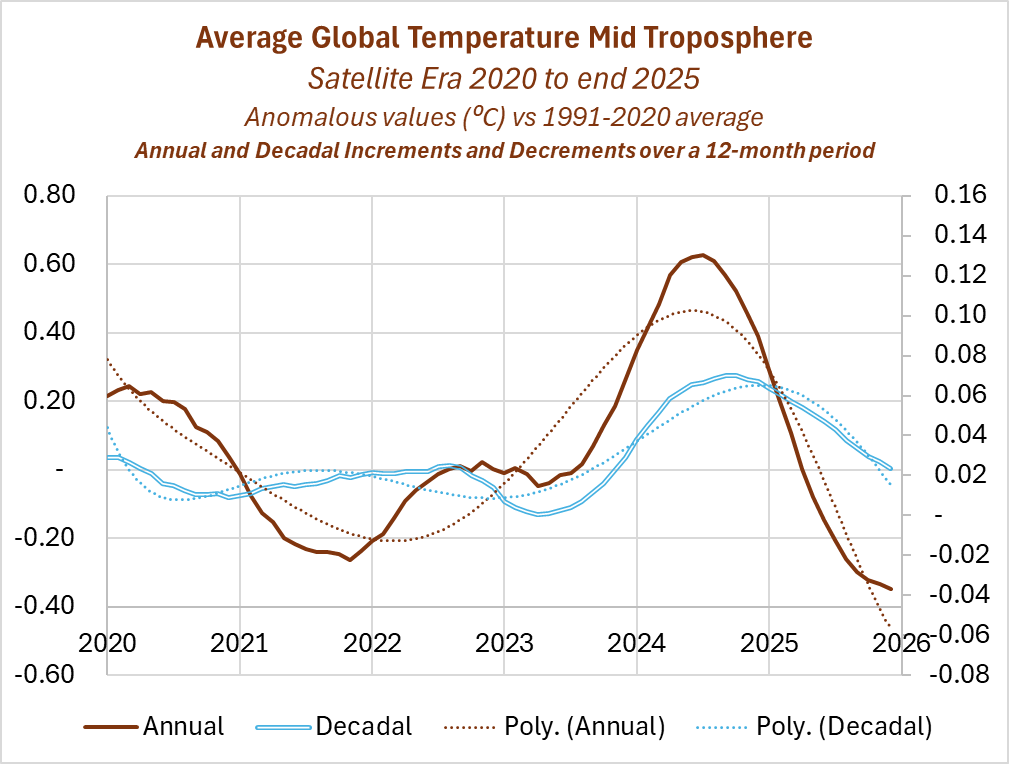
The 2020-25 more detailed graph adds very little to the picture. Once again, it shows that the cooling versus one year earlier may be tailing off - but when is anyone's guess.
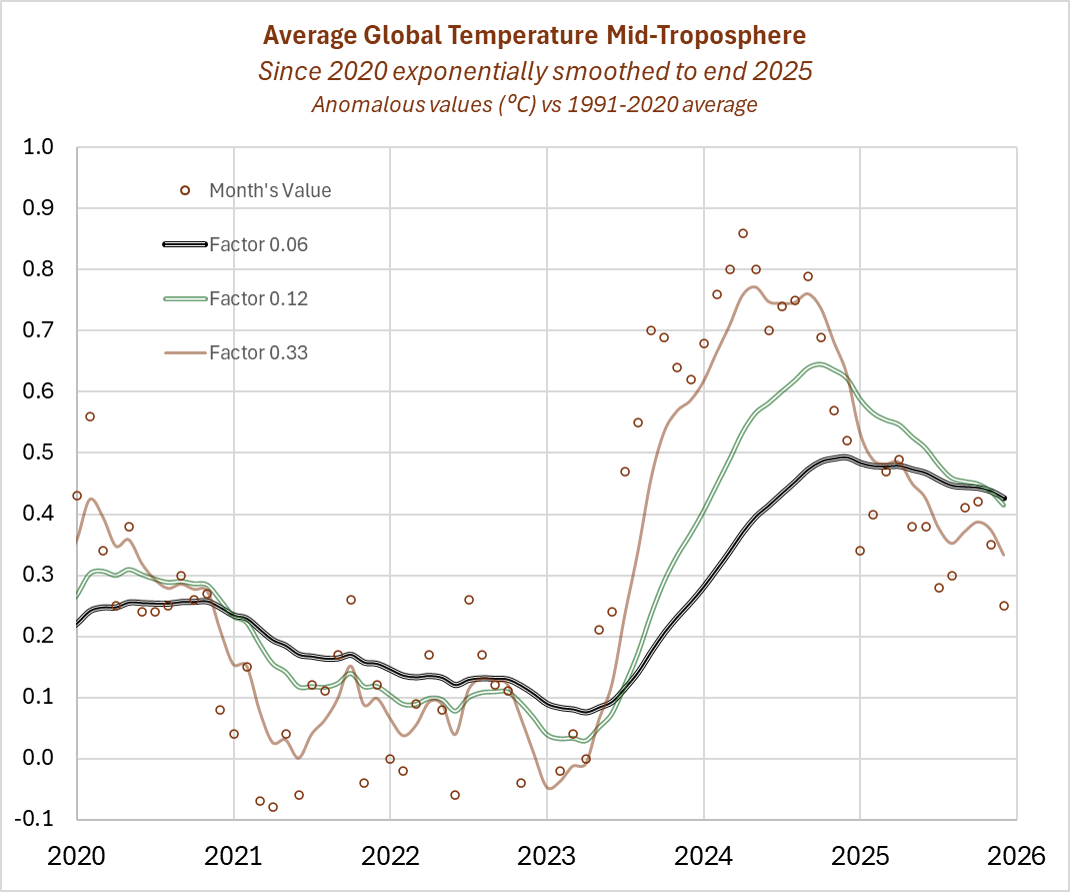
Recent Mid-Troposphere Simple Exponential Smoothed
Simple exponential smoothing is a technique to eliminate noise from graphs. A factor is used to determine how much weight is given to recent measurements. The example below shows monthly values and a series of smoother graphs with factors 0.33, 0.12 and 0.06.
All of these smoothed graphs indicate temperatures are currently on a cooling trend. The big question is how long the cooling trend will continue and to what level it will go.
Stratosphere 1980-2025
The 45-year record exhibits a falling temperature trend of -0.235 ⁰C per decade.
The impact on stratospheric temperatures of volcanoes like El Chicon and Mount Piatubo show a big rise followed by a more gentle fall over about three years.
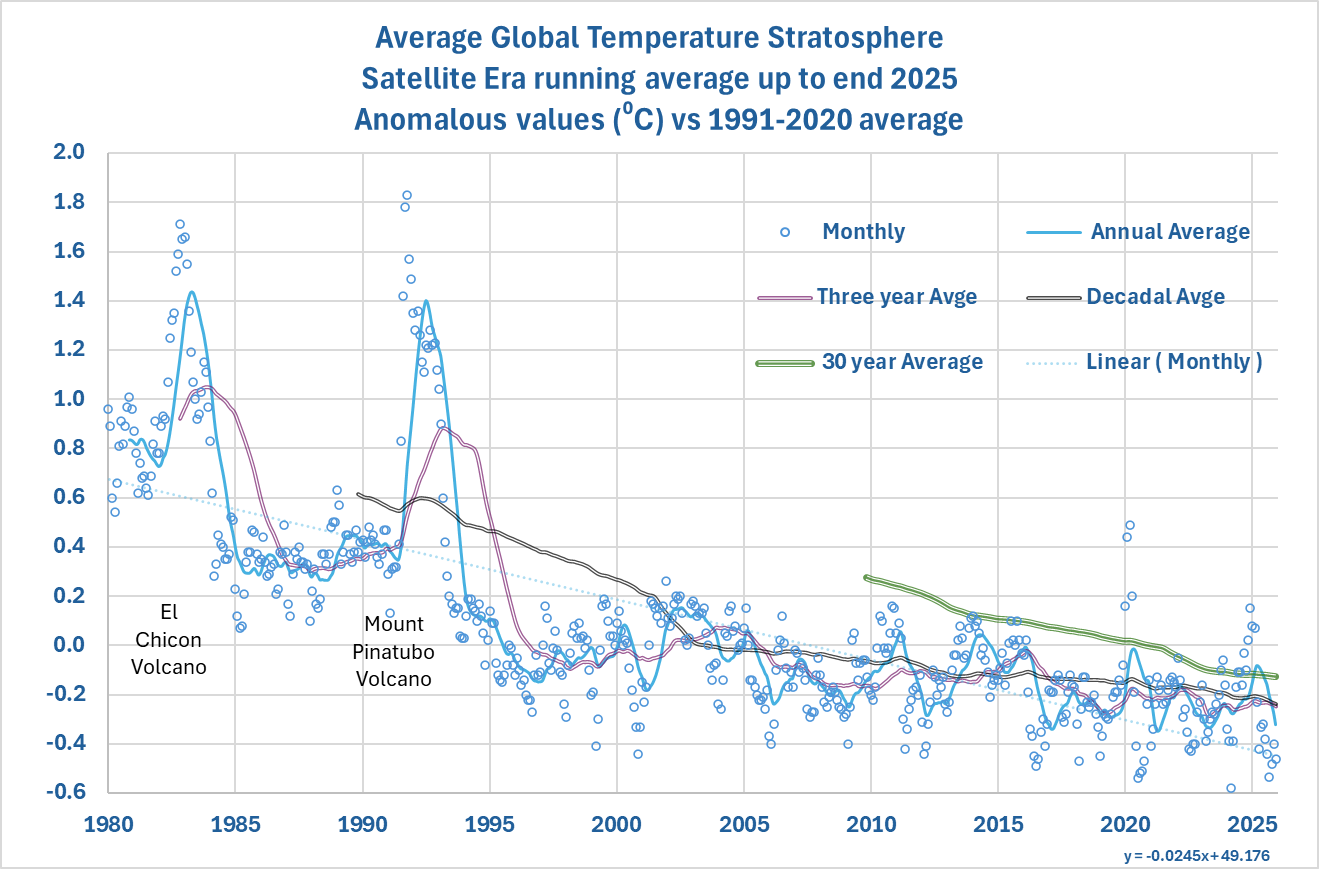
Since 1995 there have been no significant volcanoes except the 2022 Hunga Tonga–Hunga Haʻapai eruption which was a very different type of eruption than Pinatubo or El Chicon.
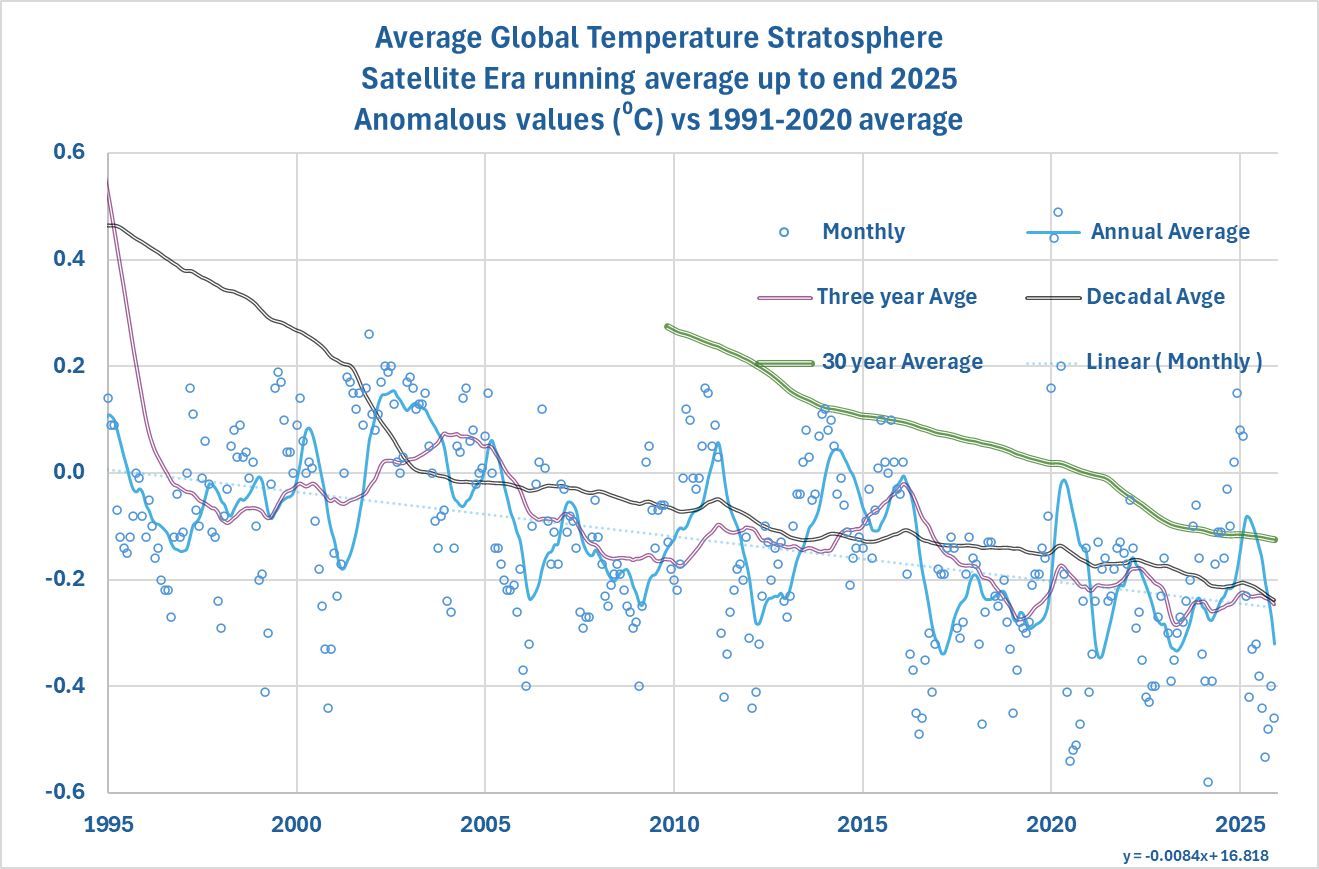
Since 1995, stratospheric temperature has show a much shallower slope in the fall - to about half of the pre-1995 fall rate.
The 30-year average and the decadal average are converging to similar fall rates.
Stratosphere 2020-2025
Ulike the Troposphere (Lower and Mid), Stratospheric temperatures exhibit a falling trend.
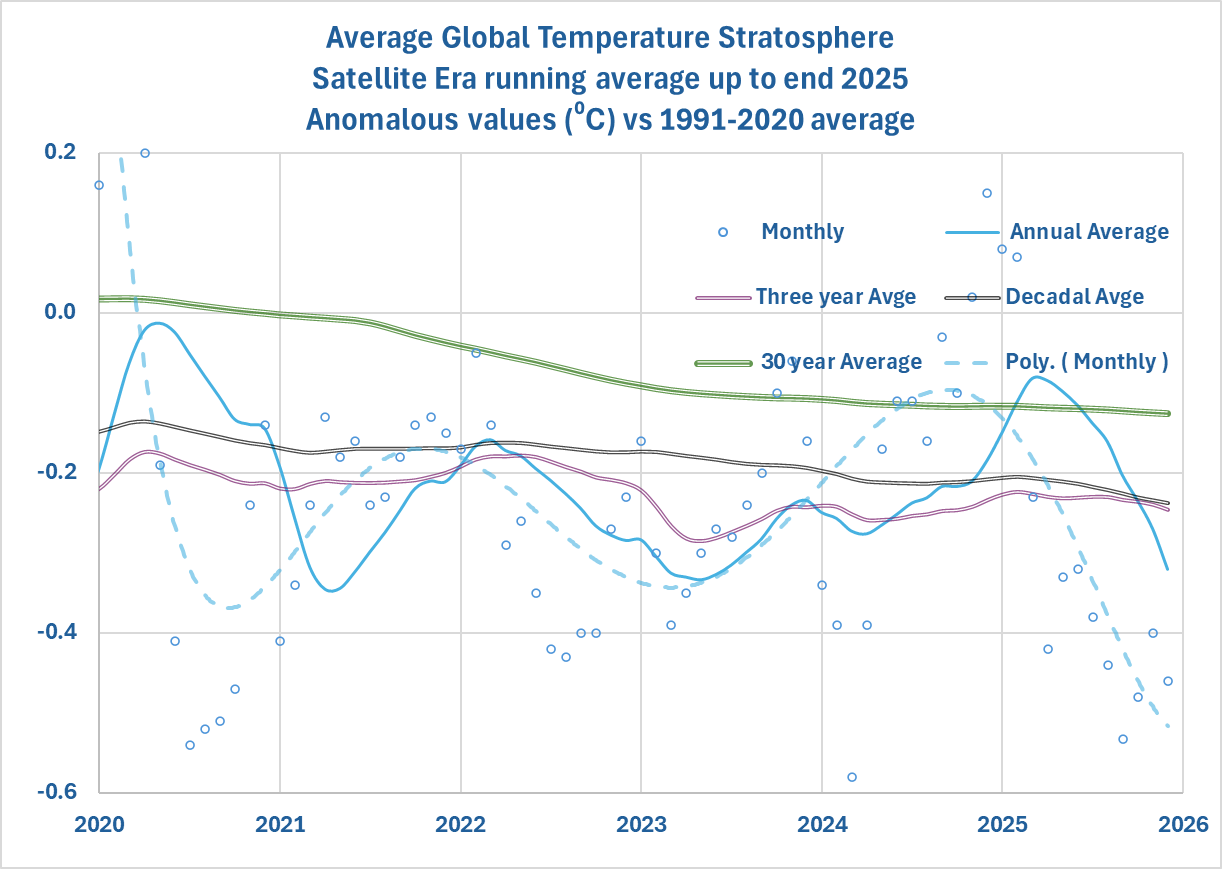
From 2021 until 2025 annual average temperatures varied up and down within a narrow range. From 2025, there has been a distinct downwaard trend in monthly and annual averages. Longer-term averages may be turning downwards.
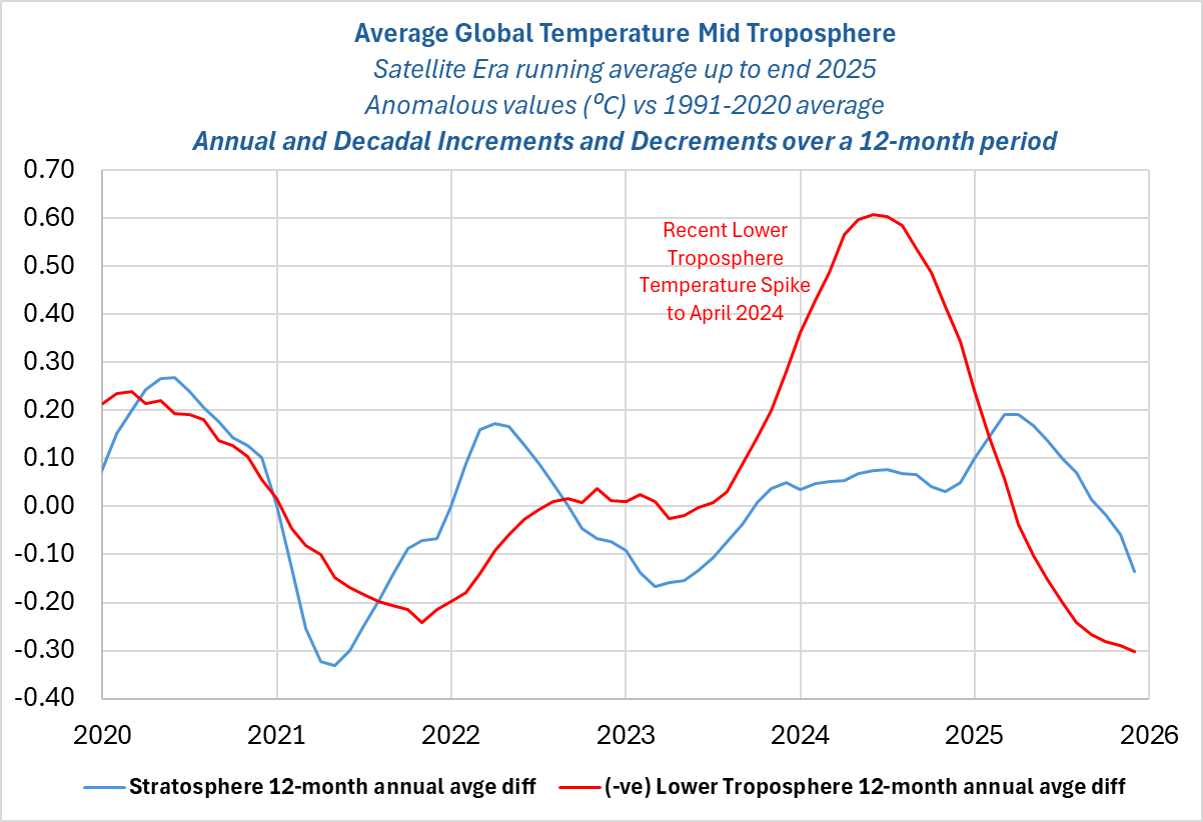
12-month differences in Annual averages: Stratosphere vs. Lower Troposphere
The narrow range (-0.3 to +0.3 ⁰C) in 12-month differences in Stratospheric temperature contrasts with the sharp spike seen in 2024 in the Lower Troposphere temperature.
Stratosphere Simple Exponential Smoothing
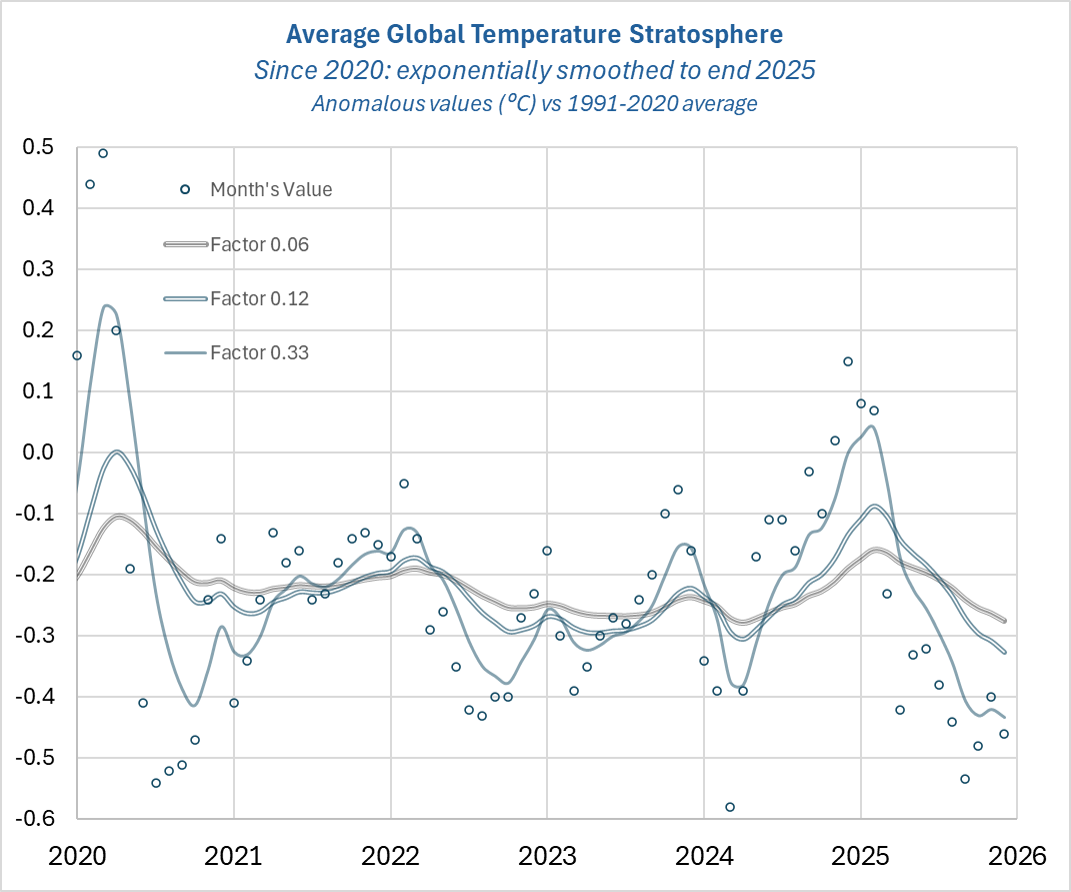
The period 2021 to mid 2024 was uneventful until late 2024 when a rise was followed by a significant fall which may still be continuing.
Temperature Difference Stratosphere-Troposphere 1980-2025 (re. Greenhouse Effect)
By considering actual temperatures for the Lower Troposphere and Stratosphere, a proxy metric may be found for the level of Global Warming contributed by carbon dioxide (and overlapping water vapour) in the 'Saturation zone'. This has little to do with increased warming due to increased atmospheric CO2 levels. See 'The Greenhouse Effect' page and my book: 'Natural and Anthropogenic Climate Variability - Volume II'.
The metric graphed here refers predominantly to the saturation zone of CO2 (aided by overlap with water). This high effective density region of the absorption spectrum is negligibly affected by increased concentrations of CO2 in the atmosphere.
Within this zone (by far the major part of the CO2 absorption region) absorption and transmission of infrared radiation continue all the way to the static temperature profile region of the Stratosphere. There may be some (minimal) augmentation from the warmer layers of the Stratosphere.
The top of the atmosphere emission is determined by the temperature of the stratosphere. Therefore the Greenhouse effect in the 'Saturation Zone' is determined by only two parameters: Surface temperature and Stratospheric temperature.
The graphs presented here considers the actual (not anomalous) temperatures, raised to the power 4 (according to Wien's law). The fundamentals of the Greenhouse effect underpin this variation in the total Greenhouse effect.
Note that the data are presented as anomalous data compared to the 'pre-industrial' period and not, as all other data in this section compared to 1990-2021 averages.
The temperatures may be read as: the increase in Global Warming in the 'Saturation zone' for carbon dioxide due to changing temperatures. This element of Global Warming is unaffected by any increase in atmospheric CO2 concentrations since pre-industrial times.
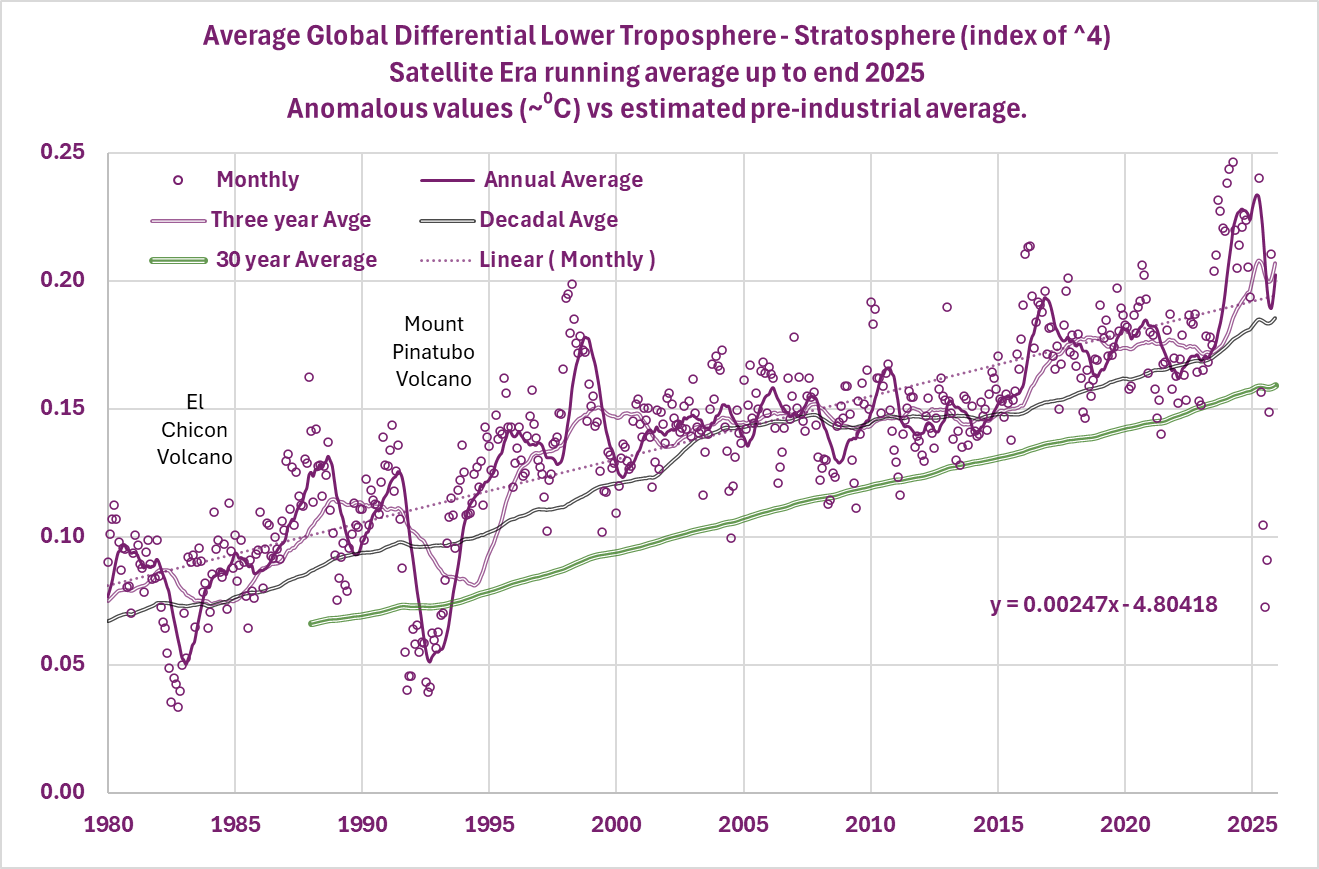
Thus the proxy contribution from carbon dioxide (and overlapping water vapour) from pre-industrial times is neary 0.2⁰C. Rising at 0.0247⁰C per decade, the current trend extrapolates to zero back in 1940-1945 which, incidentally, was the start of the post-war cooling period that ended with the hot summer of 1976.
There is high variability but some 'coincidences' with Lower Troposphere temperature may be noted. In particular the 'no change' period from 1998 to 2016.
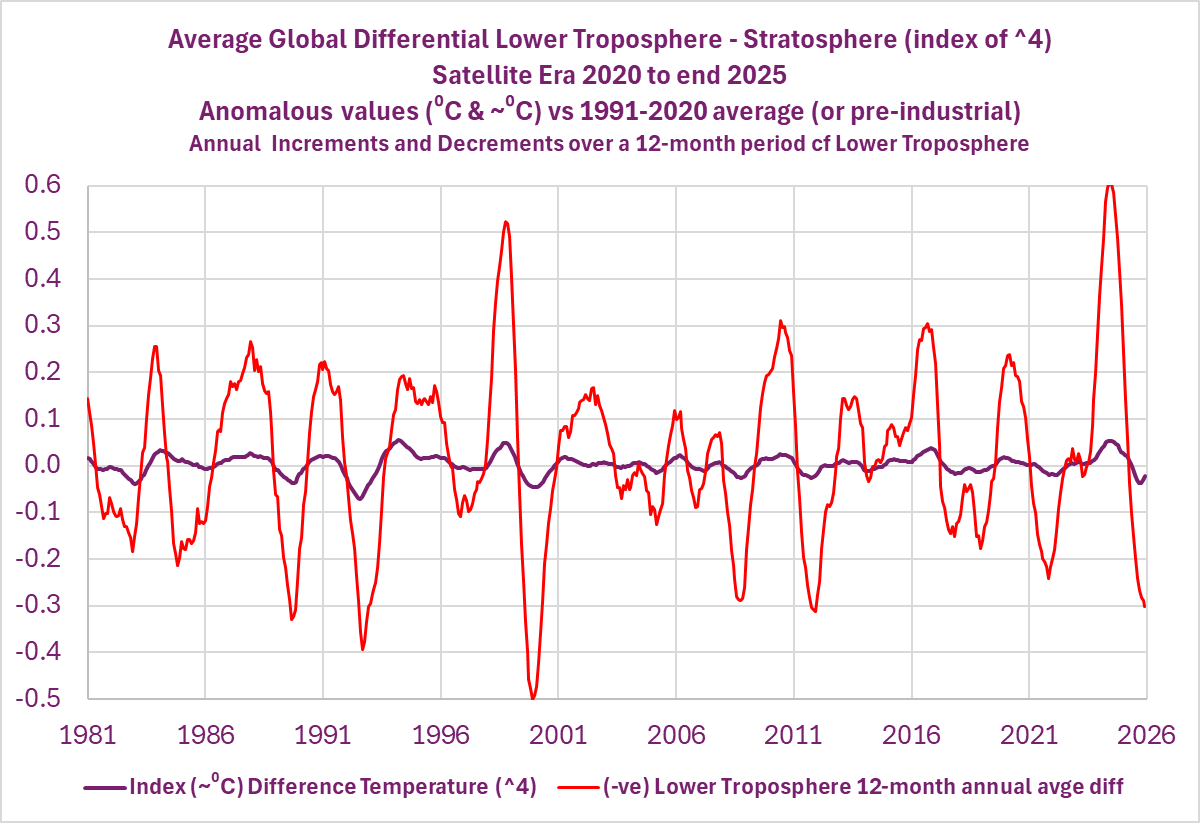
How do the 12-month differences (Strat-Trop) in annual averages compare?
Looking at how annual averages change over a 12-month period is not affected by the choice of base period (1991-2020 or 'pre-industrial'). There is a moderately high correlation between the CO2 (and overlapping water vapour) Greenhouse proxy and Lower Troposphere temperatures. This indicates that variation in the Greenhouse effect for CO2 (and overlapping water vapour) within the 'saturation zone' contribute about 10-12% to the observed variations in Lower Troposphere warming.
The proportion of the sum of effective density of CO2 to the sum of all species effective density provides an estimate of CO2's contribution. This is academic as the critical requirement for saturation is to be equal, or greater, than the threshhold value. Only at the point of being equal does any split have any meaning.
Any split of the proportion of over threshold effective density sum is meaningless but the integrated proportion of CO2 from surface to stratosphere could be anywhere from 10% to 60% - largely dependinhg on humidity in the atmosphere's lower layers. This effectively limits the 'blame' for increased Global Warming in this overlapping saturation zone to a maximum of 8% of the observed Lower Troposphere warming.
Temperature Difference Stratosphere-Troposphere 2020-2025 (re. Greenhouse Effect)
By considering actual temperatures for the Lower Troposphere and Stratosphere, a proxy metric may be found for the level of Global Warming contributed by carbon dioxide (and overlapping water vapour) in the 'Saturation zone'. This has little to do with increased warming due to increased atmospheric CO2 levels. See 'The Greenhouse Effect' page and my book: 'Natural and Anthropogenic Climate Variability - Volume II'.
The metric graphed here refers to the saturation zone of CO2 (aided by overlap with water). This high effective density region of the absorption spectrum is negligibly affected by increased concentrations of CO2 in the atmosphere.
Within this zone (by far the major part of the CO2 absorption region) absorption and transmission of infrared radiation continue all the way to the static temperature profile region of the stratosphere. There may be some (minimal) augmentation from the warmer layers of the Stratosphere.
The top of the atmosphere emission is determined by the temperature of the stratosphere. Therefore the Greenhouse effect in the 'Saturation Zone' is determined by only two parameters: Surface temperature and Stratospheric temperature.
The graphs presented here considers the actual (not anomalous) temperatures, raised to the power 4 (according to Wien's law). The fundamentals of the Greenhouse effect underpin this variation in the total Greenhouse effect.
Note that the data are presented as anomalous data compared to the 'pre-industrial' period and not, as all other data in this section compared to 1990-2021.
The temperatures may be read as: the increase in Global Warming in the 'Saturation zone' for carbon dioxide due to changing temperatures. This element of Global Warming is unaffected by any increase in atmospheric CO2 concentrations since pre-industrial times.
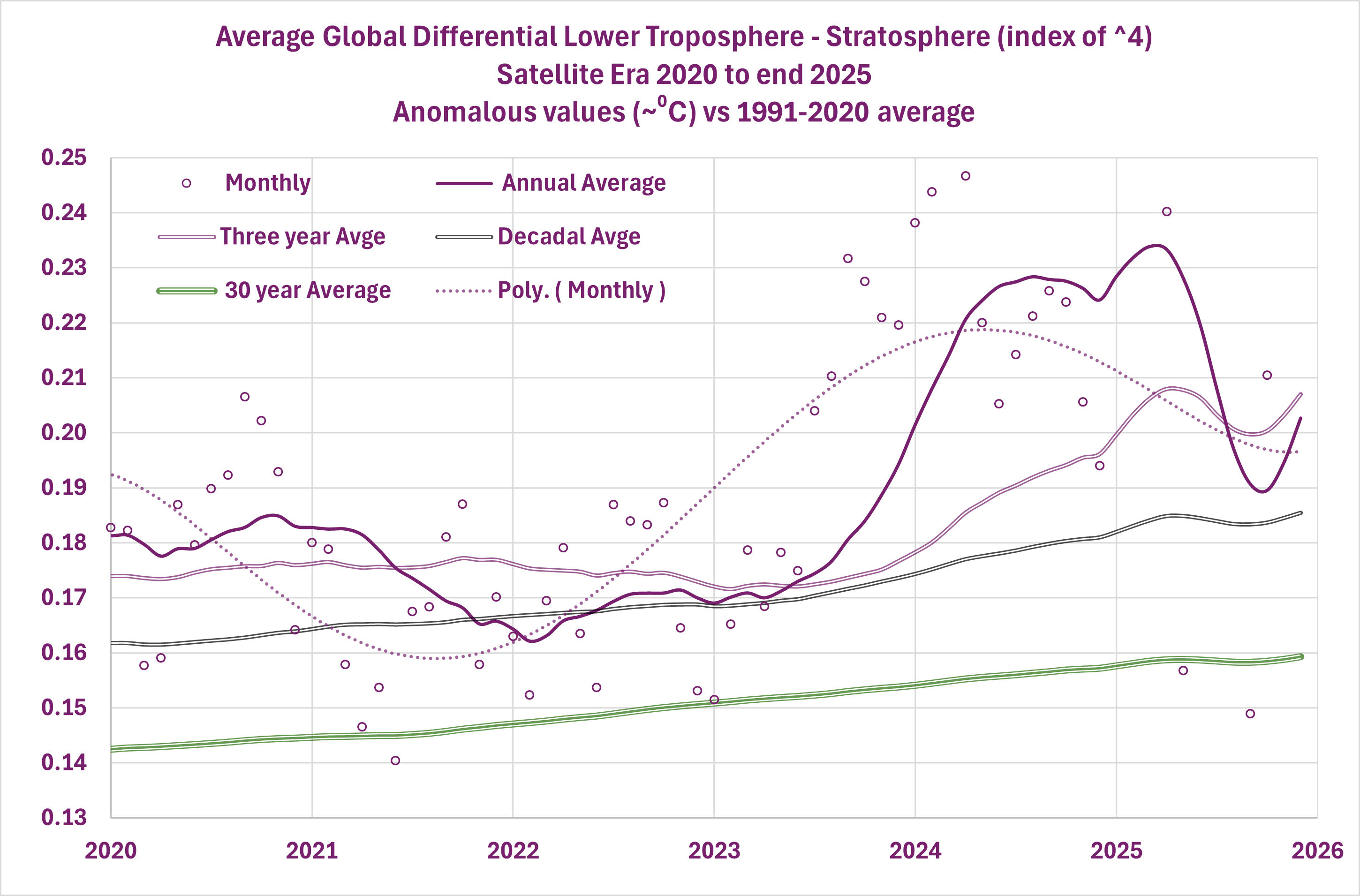
Thus the proxy contribution from carbon dioxide from pre-industrial times is neary 0.2⁰C. Rising at 0.0247⁰C per decade, the current trend extrapolates to zero back in 1940-1945 which, incidentally, was the start of the post-war cooling period that ended with the hot summer of 1976.
There is high variability but some 'coincidences' with Lower Troposphere temperature may be noted. In particular the 'no change' period from 1998 to 2016.
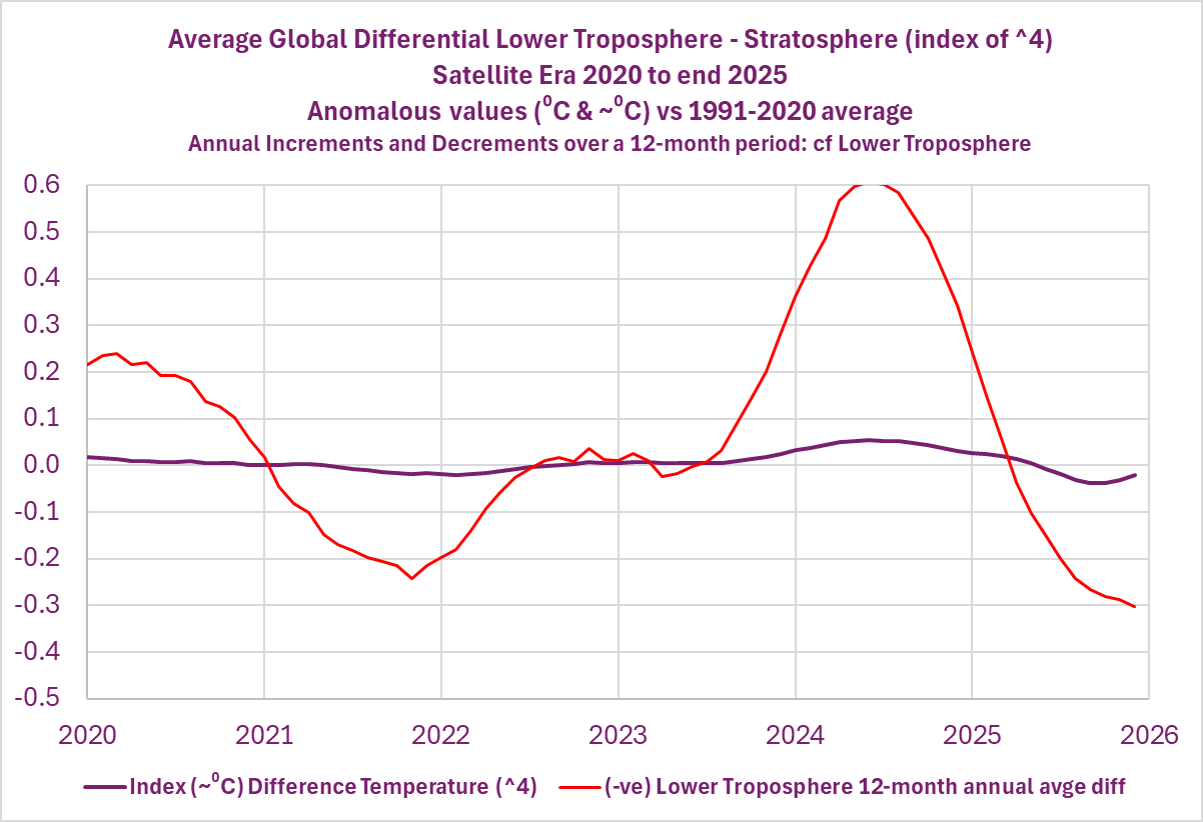
How do the 12-month differences (Stratosphere-Troposphere) in annual averages compare?
Looking at how annual averages change over a 12-month period is not affected by the choice of base period (1991-2020 or 'pre-industrial'). There is a moderately high correlation between the CO2 (and overlapping water vapour) Greenhouse proxy and Lower Troposphere temperatures. This indicates that variation in the Greenhouse effect for CO2 (and overlapping water vapour) within the 'saturation zone' contribute about 10-12% to the observed variations in Lower Troposphere warming.
Looking at how annual averages change over a 12-month period is not affected by the choice of base period (1991-2020 or 'pre-industrial'). There is a moderately high correlation between the CO2 (and overlapping water vapour) Greenhouse proxy and Lower Troposphere temperatures. This indicates that variation in the Greenhouse effect for CO2 (and overlapping water vapour) within the 'saturation zone' contribute about 10-12% to the observed variations in Lower Troposphere warming.
The proportion of the sum of effective density of CO2 to the sum of all species effective density provides an estimate of CO2's contribution. This is academic as the critical requirement for saturation is to be equal, or greater, than the threshhold value. Only at the point of being equal does any split have any meaning.
Any split of the proportion of over threshold effective density sum is meaningless but the integrated proportion of CO2 from surface to stratosphere could be anywhere from 10% to 60% - largely dependinhg on humidity in the atmosphere's lower layers. This effectively limits the 'blame' for increased Global Warming in this overlapping saturation zone to a maximum of 8% of the observed Lower Troposphere warming.
Stratosphere-Troposphere differentials - Simple Exponential Smoothing
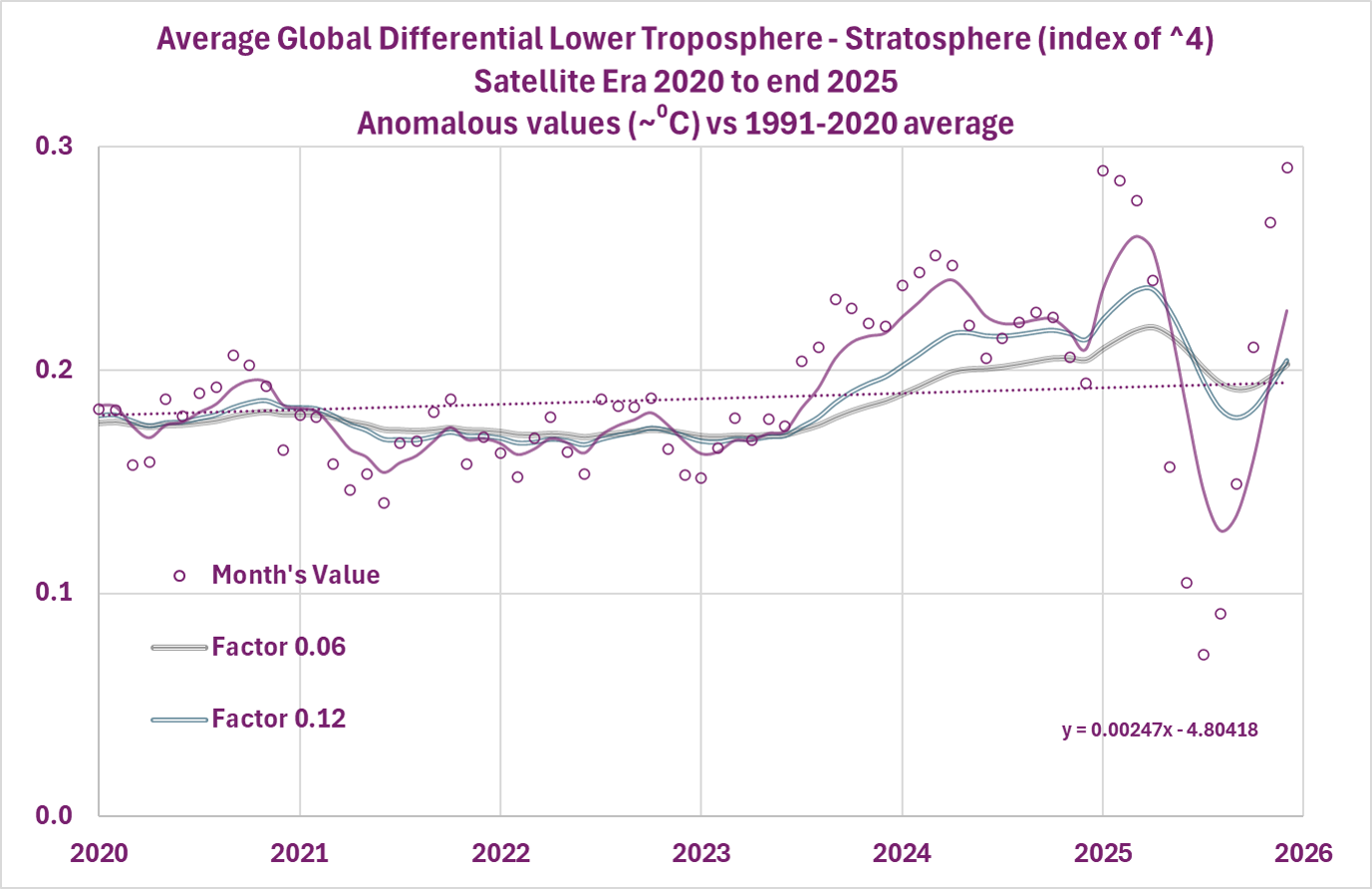
The level of variability seen in this metric over the last two years makes it difficult to discern any medium term trend.
In the continued absence of a new trend appearing, it might be expected that the slight upward trend (+0.025 per decade) will continue.