Addendum Two Methane
The contribution from methane to the total Greenhouse effect is:
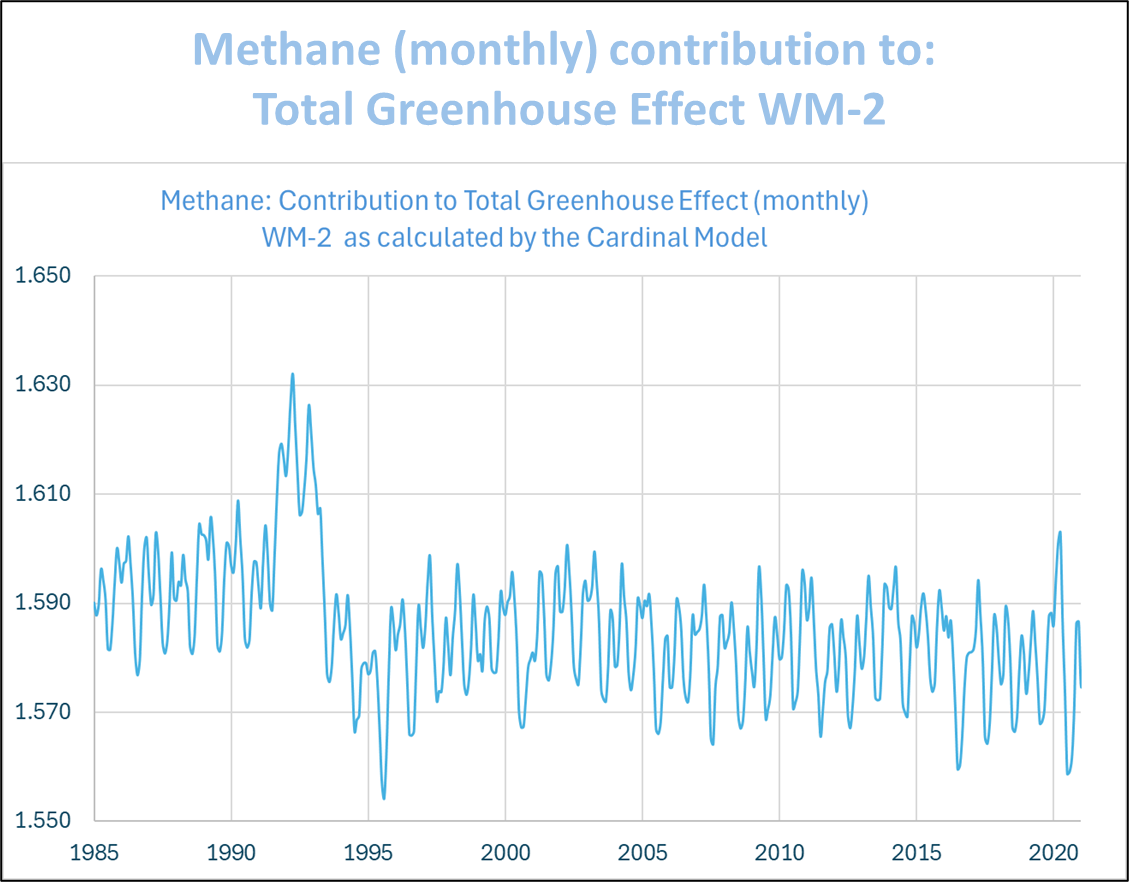
Most of the variability observed comes from changes in temperatures (lower and mid Troposphere and lower Stratosphere).
For Methane, the effective emission altitude for the saturation zone is determined by the Cardinal Model to be near the lower Stratosphere.
For Methane's broadening/overlap zone the effective emission altitude averages between 3- and 4-kilometres altitude.
By looking at annual averages (thereby averaging out seasonal effects) and adjusting for temperature variations, the progression of methane’s contribution to the total Greenhouse effect may be plotted against ground-level methane concentration.
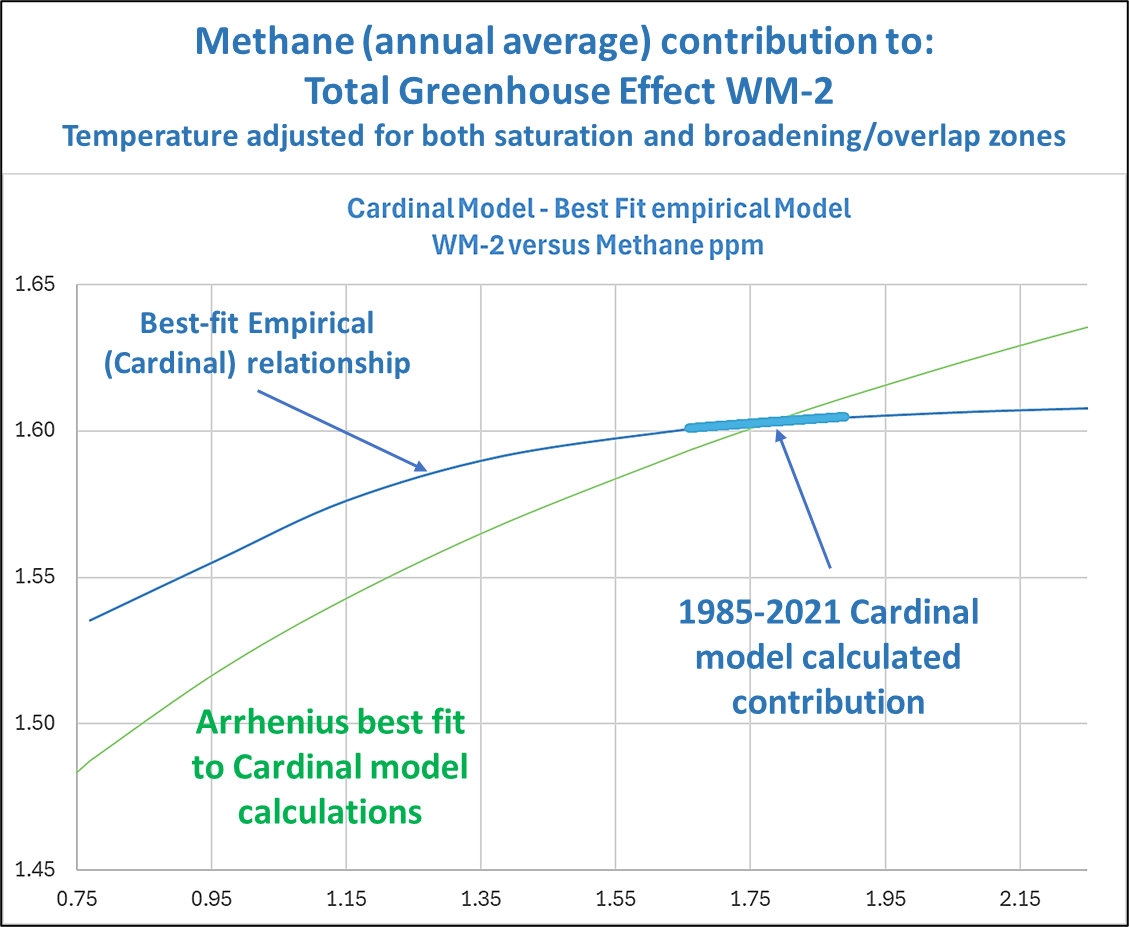
The green line is of the form proposed by Arrhenius and is the form used as the foundation relationship for Anointed Modellers.
The best fit to Cardinal model calculated data is: WM-2 = 0.214 ln(1,000 methane ppb)
The blue line follows a combination of an Arrhenius form and a proposed empirical relationship based on the author’s experience studying reflection, refraction, transmission and absorption of far-infrared and microwave radiation in his late-1960s laboratory:
- Greenhouse effect = a tanh(b 1000 * Methane concentration in ppb)
- Where: a = 1.54 and b = 1.86
Note hyperbolic tangent [tanh] is a mathematical function that describes various physical processes involving radiation interaction with matter - see further Addendum three.
The [tanh] form at pre-industrial levels of methane (0.72 ppb) is still on a steeper curve than observed for CO2 as its concentration is one 385th of the CO2 concentration.
The curve has flattened considerably at the CH4 concentrations seen more recently (1.8 to 1.9 ppm)
The value for ‘tripling’ from 0.77 to 2.31 ppm (c.f. current levels of 1.95 ppm) is 0.09 WM-2 (<0.02⁰C) derived from this empirical curve.
The Arrhenius form model derives estimates for ‘tripling’ is more than double this.