Lower Troposphere Historic to 2025
The Lower Troposphere (global) data is a comprehensively measured metric used for the temperature at the Earth’s surface.
The data breaks monthly averages into different regions but the most often quoted statistic is 'Average Global Temperature' which is the acccumulation of many regional data into a Global average.
The graph, below, shows monthly and average data up to the end of 2025. The average data incorporates some estimates pre-dating the start of the satellite era going back to 1958.
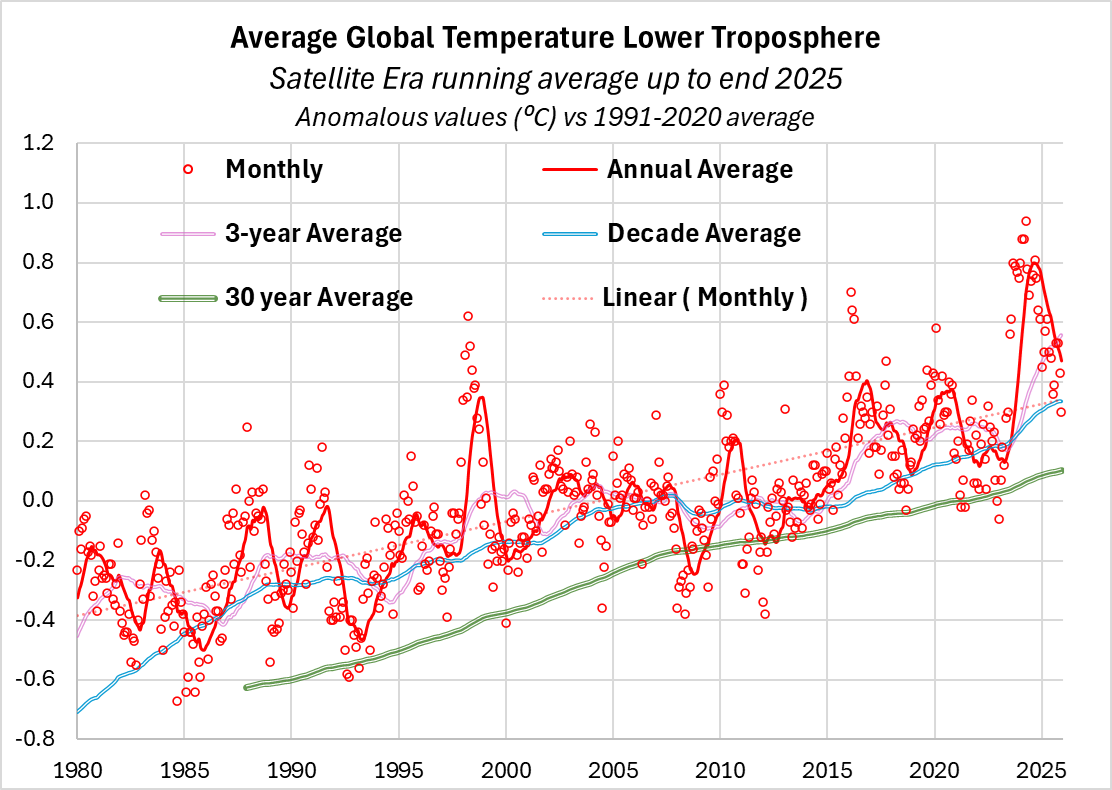
The monthly data is highly variable with a linear trend of +0.158 ⁰C per decade.
The variability smooths out as the period of the average extends from one year, 3-years, decadal and 30-years.
Considering the decadal averages, the line was on an upward trend until the decade 1998 to 2007. From that decade until the decade 2007 to 2016 the decadal average was flat. This means that from the late 1990s until 2016 temperatures showed no decadal-long trend.
Long-term Trends
The best fit (by variance minimisation) to these monthly data yield a highly smoothed temperature profile.
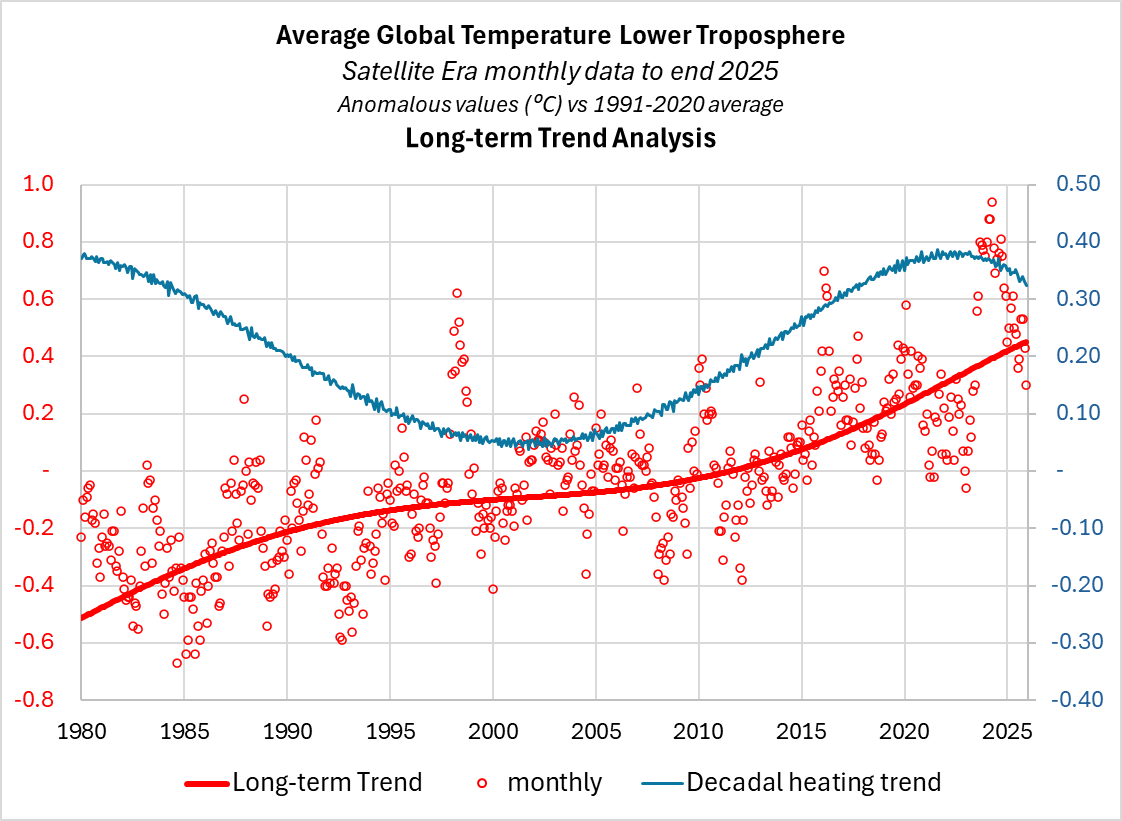
The solid red line is the smoothed ‘best-fit’ long trend while the blue line is an estimate of the decadal warming tend.
This starts out showing the in mid-1970s /1980, decadal warming was as much as 0.4 ⁰C but fell to near zero in the late 1990s/early 2000s.
The rate of warming picked up from 2010 to nearly 0.4 ⁰C per decade but, despite the temperature spike to April 2024, it is trending down for over a year.
How are annual and decadal averages changing over 12 months?
There are often comments that a year has been 'the hottest on reccord' or the 'second hottest year ever'
It is more interesting to see how the annual average difference trend month-by-month.
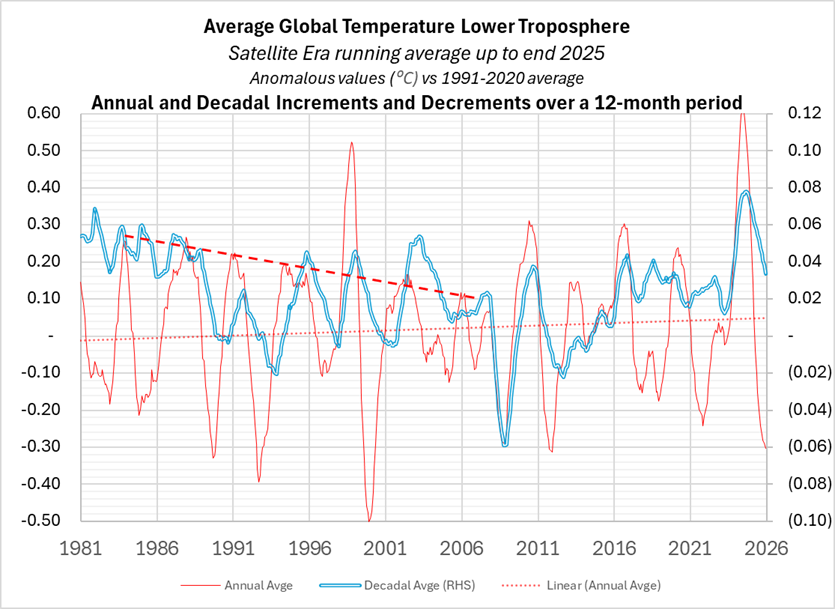
The graph below shows that the 12-month difference between annual averages has twice, in the last 30 years shot up to +0.5 to +0.6⁰C.
The first was to around the hot month of April 1998 (+0.62⁰C) as the Kyoto Protocol and the second to the recent record-breaking April 2024 (+0.94⁰C).
The 1998 peak year was an exception in what for the 27-year period (1981 to 2008) a period of falling 12-month difference peaks. It was followed the sharpest cooling (over 12-months) event in the last 45 years.
Most recently the rise to April 2024 elicited alarming comments from world leaders including the General Secretary of the UN (Guterres) waarning about ‘Boiling seas'.
For over a years the 12-month difference in annual average has been on a falling trend
Where the current sharp-fall will end is anybody’s guess. Whether it will falll by 1.0⁰C to -0.4⁰C - the same fall as the 1998 peak (which fell from +0.5⁰C to -0.5⁰C) is uncertain. It has already fallen by 0.9⁰C but the fall is showing signs of tail-off.
Decadal rises and falls (plotted of the Right Hand Scale) tend say more about the modern warm period than is evident in annual averages.