Temperature Difference 1980-2025 (re. CO2 Greenhouse Effect)
By considering actual temperatures for the Lower Troposphere and Stratosphere, a proxy metric may be found for the level of Global Warming contributed by carbon dioxide (and overlapping water vapour) in the 'Saturation zone'. From 'The Greenhouse Effect for Laypersons':
‘Saturation Zone’ (where the effective density remains sufficiently high):
absorption and transmission continue all the way to the static temperature profile of the stratosphere (with some augmentation from the warmer layers of the Stratosphere). The top of the atmosphere emission is determined by the temperature of the stratosphere. Therefore the Greenhouse effect in the 'Saturation Zone' is determined by only two parameters: Surface temperature and Stratospheric temperature. The graphs presented here considers the actual (not anomalous) temperatures, raised to the power 4 (Wien's law). The data are presented as anomalous data compared to the 'pre-industrial' period and not, as all other data in this section compared to 1990-2021.
The temperatures may be read as:
The increase in Global Warming in the 'Saturation zone' for carbon dioxide due to changing temperatures. This element of Global Warming is unaffected by any increase in atmospheric CO2 concentrations since pre-industrial times.
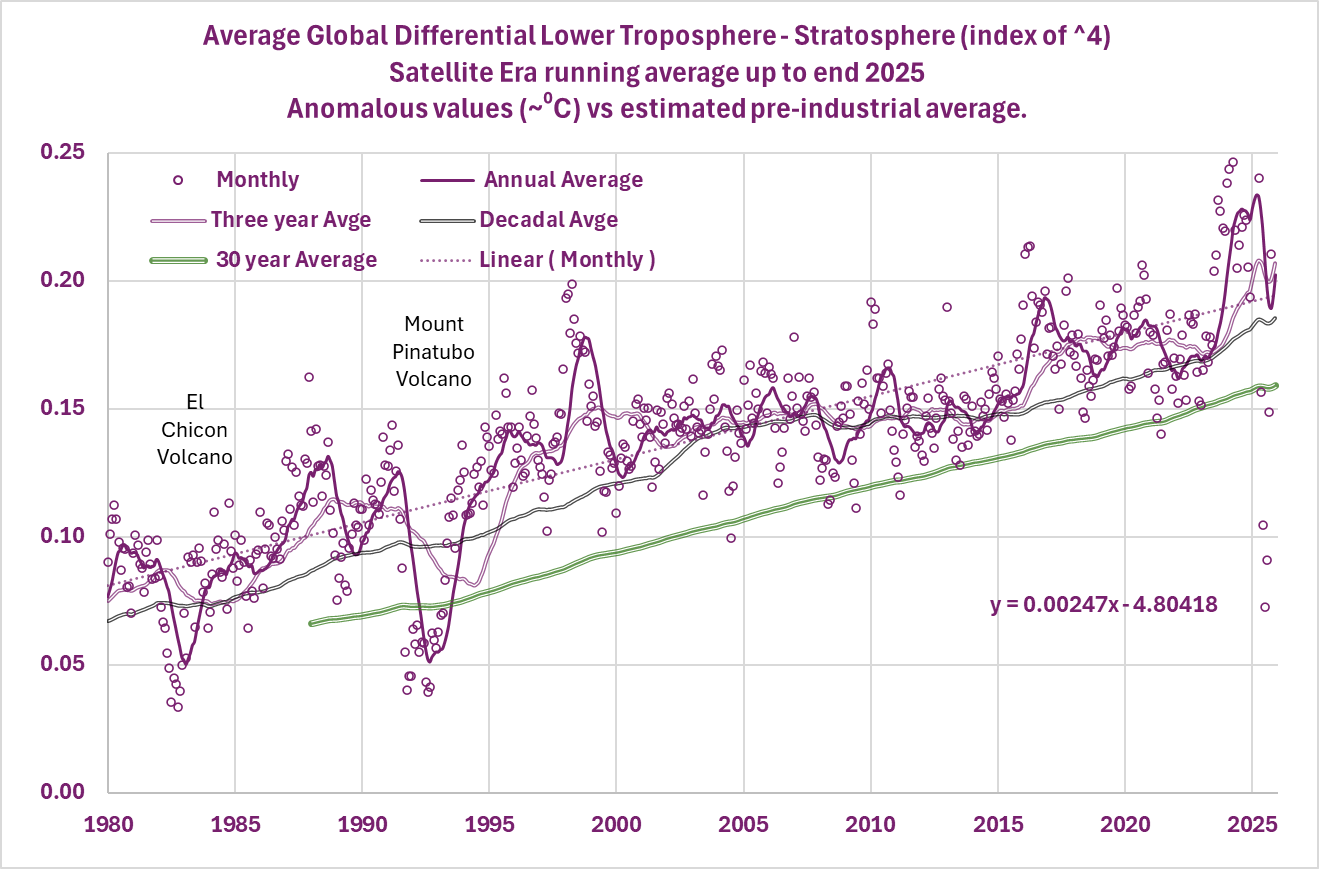
Thus the proxy contribution from carbon dioxide (and overlapping water vapour) from pre-industrial times is neary 0.2⁰C. Rising at 0.0247⁰C per decade, the current trend extrapolates to zero back in 1940-1945 which, incidentally, was the start of the post-war cooling period that ended with the hot summer of 1976.
There is high variability but some 'coincidences' with Lower Troposphere temperature may be noted. In particular the 'no change' period from 1998 to 2016.
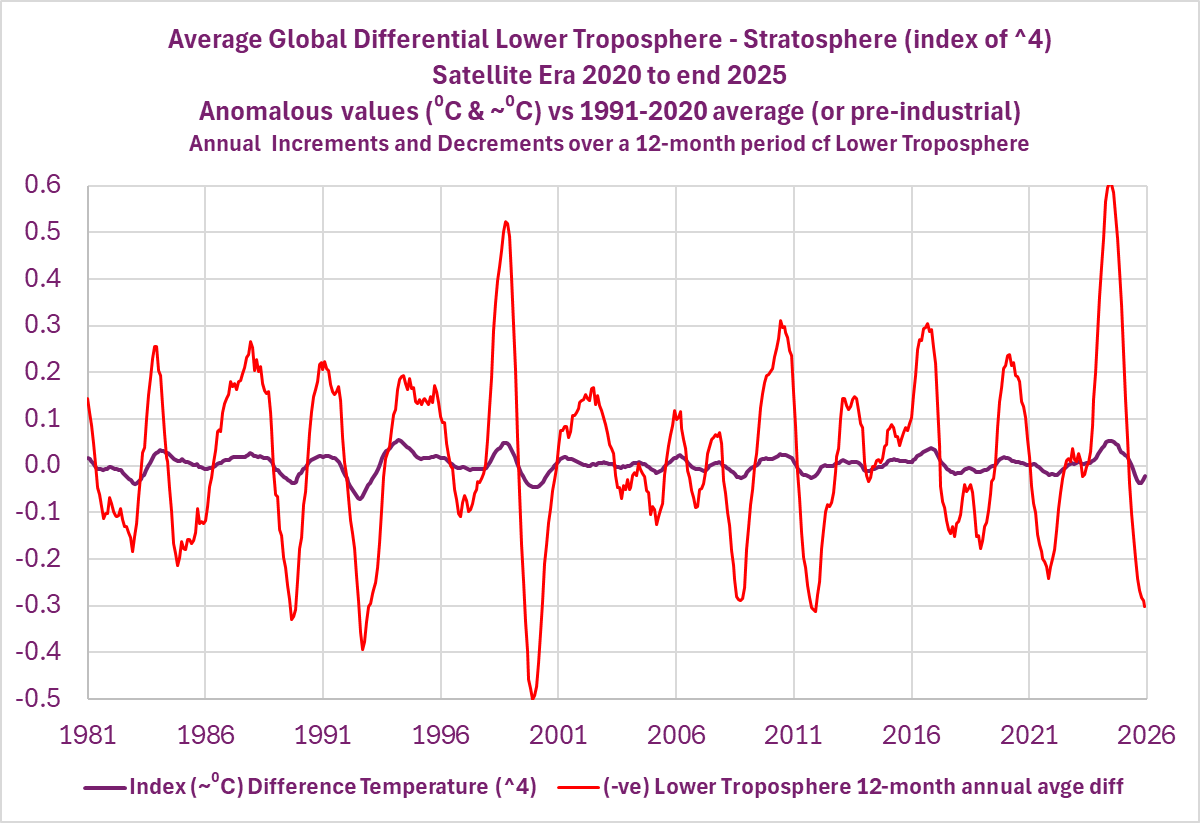
How do the 12-month differences in annual averages compare?
Looking at how annual averages change over a 12-month period is not affected by the choice of base period (1991-2020 or 'pre-industrial'). There is a moderately high correlation between the CO2 (and overlapping water vapour) Greenhouse proxy and Lower Troposphere temperatures. This indicates that variation in the Greenhouse effect for CO2 (and overlapping water vapour) within the 'saturation zone' contribute about 10-12% to the observed variations in Lower Troposphere warming.
The proportion of the sum of effective density of CO2 to the sum of all species effective density provides an estimate of CO2's contribution. This is academic as the critical requirement for saturation is to be equal, or greater, than the threshhold value. Only at the point of being equal does any split have any meaning.
Any split of the proportion of over threshold effective density sum is meaningless but the integrated proportion of CO2 from surface to stratosphere could be anywhere from 10% to 60% - largely dependinhg on humidity in the atmosphere's lower layers. This effectively limits the 'blame' for increased Global Warming in this overlapping saturation zone to a maximum of 8% of the observed Lower Troposphere warming.