Addendum Three: A note about Empirical curves
The empirical curves mentioned above are an attempt to fit an empirical curve to the data coming from the Cardinal model.
There is no direct relationship between the surface temperature and the effect of incremental Greenhouse gas concentrations in the atmosphere.
The mechanism of the Greenhouse effect is explained in the section ‘The Greenhouse Effect’ and is a near instantaneous (for human observers) heating of the atmosphere. The atmosphere warms from the Greenhouse effect when the Earth’s surface is warm (i.e. during warm days – particularly if cloudless) and cools at other times. There is a degree of latency involved but the best temperature to characterise Greenhouse warming is the mid Troposphere temperature.
The Cardinal model evaluates the contribution to the total Greenhouse effect coming from increased concentrations levels.
By assuming all this increase leads directly to surface warming, the Cardinal model output can be used to derive an empirical relationship for suface warming.
The relationship derived theoretically by Anointed modellers is an Arrhenius [ln] form:
- Greenhouse effect = a * ln (concentration).
For CO2, Anointed modellers use a factor a = 5.35 when concentration is in ppm. The ‘best fit’ Arrhenius form curve for the Cardinal model data is a factor a = 5.7.
However, this Arrhenius-form curve is a very poor fit and I proposes a curve based on hyperbolic tangent (tanh) of
- Greenhouse effect = a tanh (b concentration)
The [tanh] form of curve best fits what is observed from the Cardinal Model.
The [ln] and [tanh] forms are illustrated in the following diagram (for CO2 and CH4):
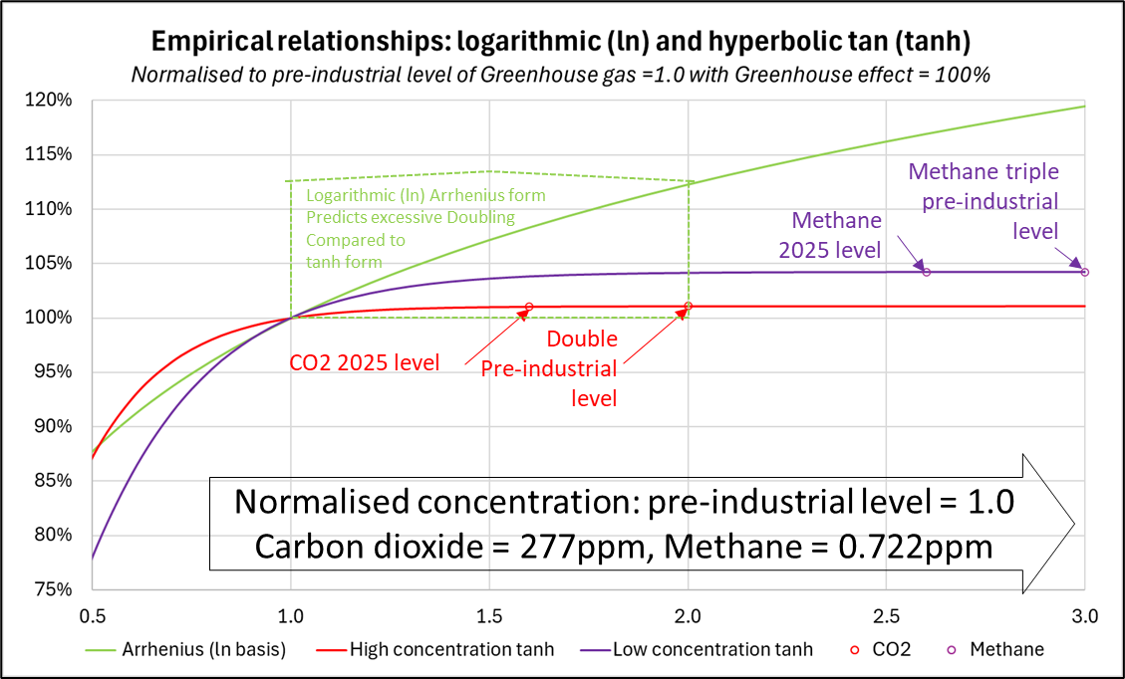
The curves are presented in normalised form with the x-axis being multiples of the concentration in pre-industrialised times and the y-axis being %ges of the pre-industrial concentration Greenhouse effect.
All curves pass through the 100% point at x = 1 (the pre-industrial concentration).
The green curve illustrates the one Arrhenius [ln] form curve. It is a one-parameter curve.
The [tanh] form represents a family of curves depending on the value of b in the relationship: Greenhouse effect = a tanh (b concentration).
Two lines are illustrated: the red line is the [tanh] curve that best fits the Cardinal data for carbon dioxide while the purple line is the best fit for Methane.
Generally, the [tanh] curve levels off at higher concentrations which suggests that the underlying processes generating the observe data from the Cardinal model are:
• At very low concentrations, none of the spectral lines are saturated so the absorption as concentrations increases proceeds, arguably, in the manner proposed by Anointed modellers – more in the fashion of a direct logarithmic relationship.
• As concentration increases more and more of the spectral lines attain saturation so enter the ‘broadening / overlap’ zone as described in 'The Greenhouse Effect'. This results in the curve ‘flattening out’.
The above curves are empirically derived curves from analysing the observed data and have no underlying numeric theory – they describe the system ‘as it is observed’ and not like ‘it is asserted to be’.