Lower Troposphere Since 2020
The graph of differnt period averages (annual, 3-year, decade and 30-year) is expanded for the six years 2020 to 2025.
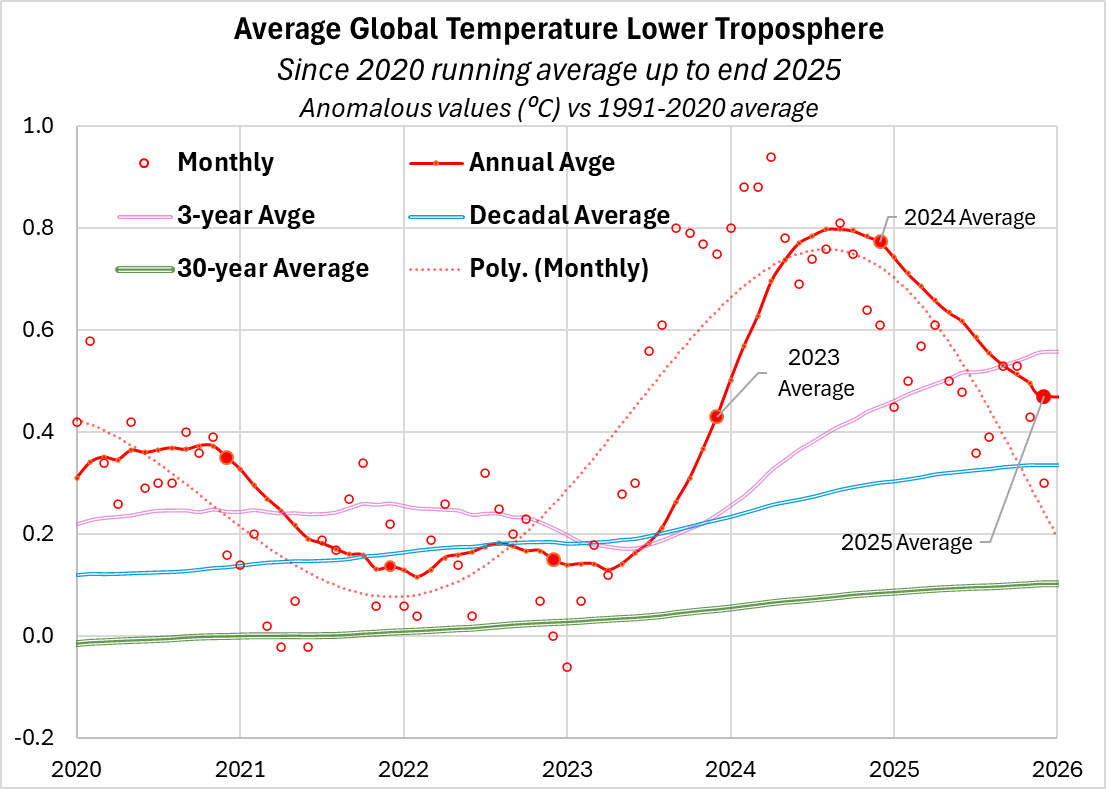
A 'best fit' line is added for the monthly data although it is a poor fit (R-suared 0.73).
The specific years 2023, 2024 and 2025 are noted showing that 2023 wass on the way up to the exceptionally hot year of 2024 while 2025 is on the way down.
There is still no cogent explanation for the blip up that peaked around 1.5 to 1.6 ⁰C above pre-industrial temperatures.
Clearly, elevated carbon dioxide (since pre-industrial times) is not even a contributing factor explaining the blip.as the seasonality of its concentration was well within 'normal expectated variations''
.Some possible explanations may include the longet-term effect of the Hunga Tonga 2022 eruption which was very different to most volcanic eruptions and thre huge amounts of water into the Lower Stratosphere affecting the Greenhouse absorbtion / emission of waater and the associated variation in ozone.
Other natural factors may include ocean current variation (particularly ENSO and AMOC) and unseasonally reduced cloud allowing more sun's heat through to the surface.
The annual, decadal and 30-year averages all show a slowing-down or dropping off trend. The exception is the three-year running average which shown an upward trend. For alarmist purposes, the three year average profile is the only one that indicates a strong warming trend. This may explain why some EU agency commentators are choosing to major on the three-year average.
How are annual and decadal averages changing over 12 months?
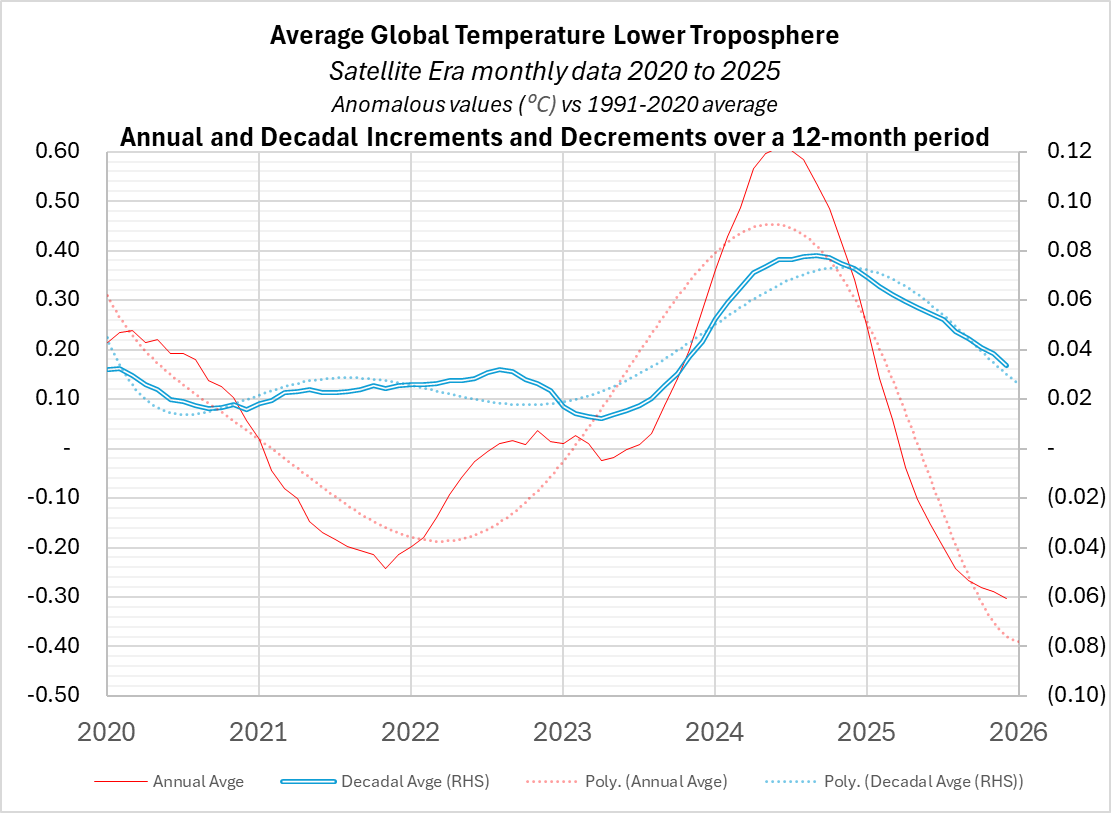
The 2020-25 more detailed graph adds very little to the picture. Once again, it shows that the cooling versus one year earlier may be tailing off - but when is anyone's guess.
Simple Exponential Smoothed
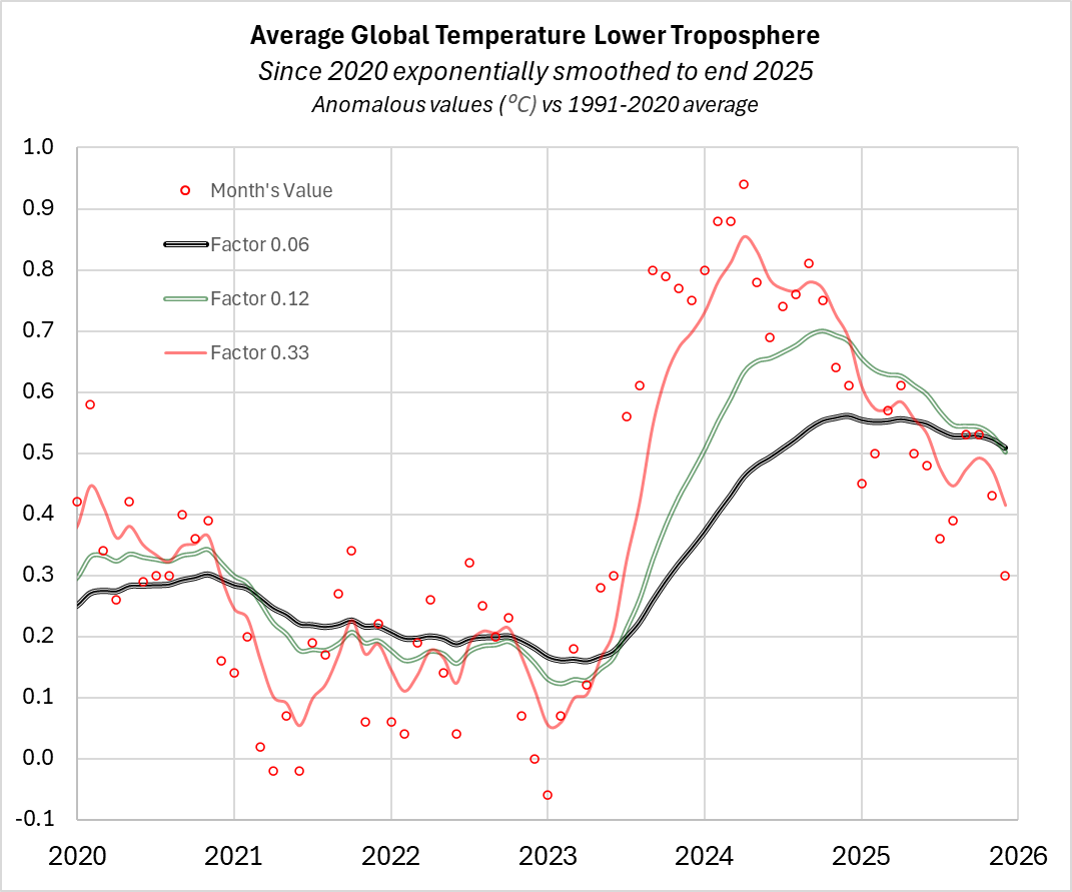
Simple exponential smoothing is a technique to eliminate noise from graphs. A factor is used to determine how much weight is given to recent measurements. The example below shows monthly values and a series of smoother graphs with factors 0.33, 0.12 and 0.06.
All of these smoothed graphs indicate temperatures are currently on a cooling trend. The big question is how long the cooling trend will continue and to what level it will go.