Mid-Troposphere 1980-2025
The Mid Troposphere (global) data is a comprehensively measured metric used for the temperature in the mid-Troposphere. If there is a measure of the average temperature (anomalies) for the whole atmosphere this may be as close as possible of the reported metrics.
The data breaks monthly averages into different regions but the most often quoted statistic is 'Average Global Temperature' which is the acccumulation of many regional data into a Global average.
The graph, below, shows monthly and average data up to the end of 2025. The average data lines start where data is available as no reliable mid-Troposphere data was available in pre-satellite times.
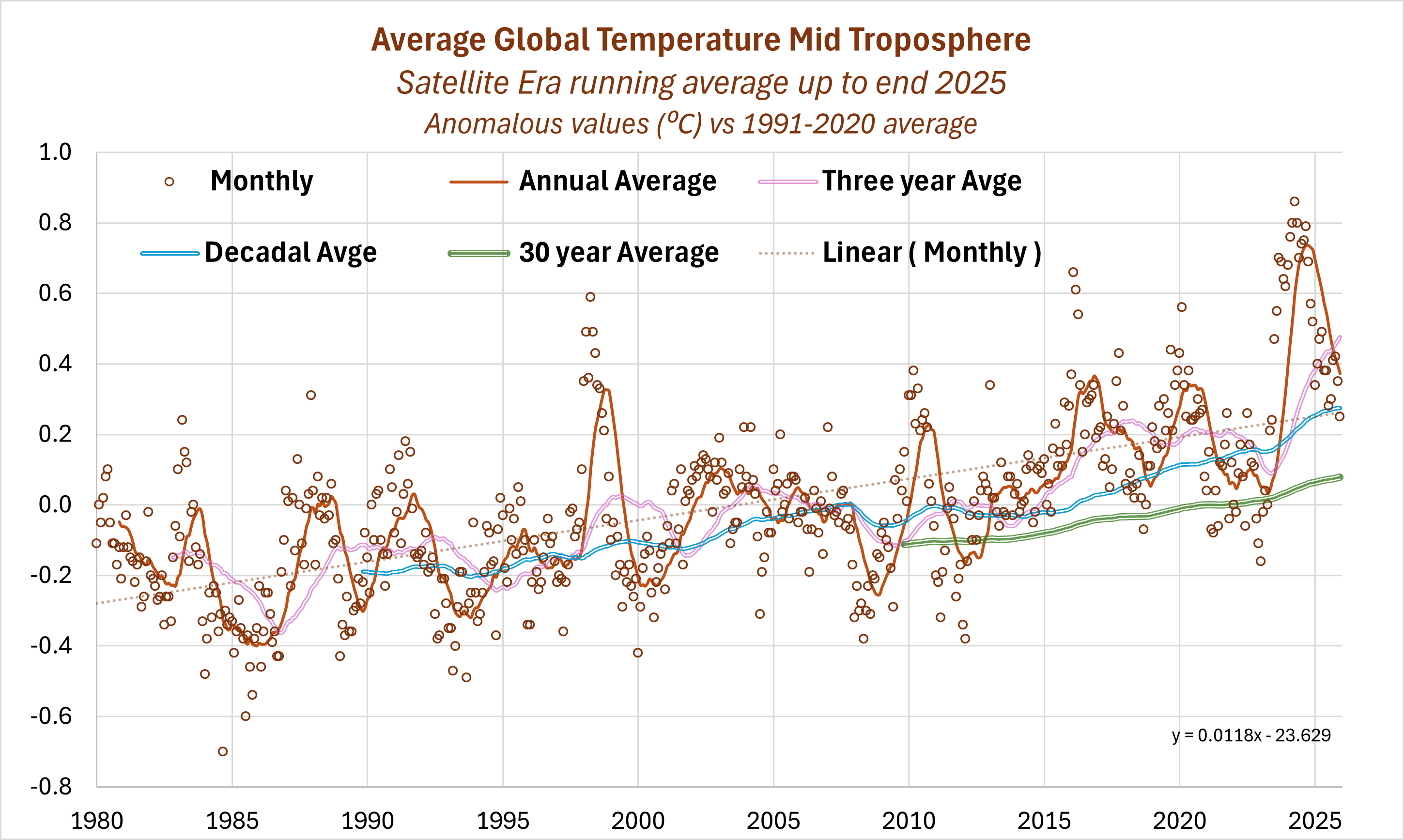
The monthly data is highly variable with a linear trend of +0.118 ⁰C per decade.
The mid-Troposphere plot is similar in form to the Lower Troposphere plot. The variability is not as extreme and the decadal average heating rate is 25% less than the Lower Troposphere.
The variability smooths out as the period of the average extends from one year, 3-years, decadal and 30-years.
The 3-year average line was on an upward trend until 1998. From the to 2015 (18 years) the 3-year average was essentially flat. During that period CO2 increased 37ppm (over 10%) which according to the models of the Anointed the augmentation of Greeenhouse effect should have raised global average mid-Troposphere by between 0.5 and 1.6⁰C.
How are annual and decadal averages changing over 12 months?
It is interesting to see how the annual average difference trend month-by-month and how it ccompares to a similar graph for the Lower Trroposphere.
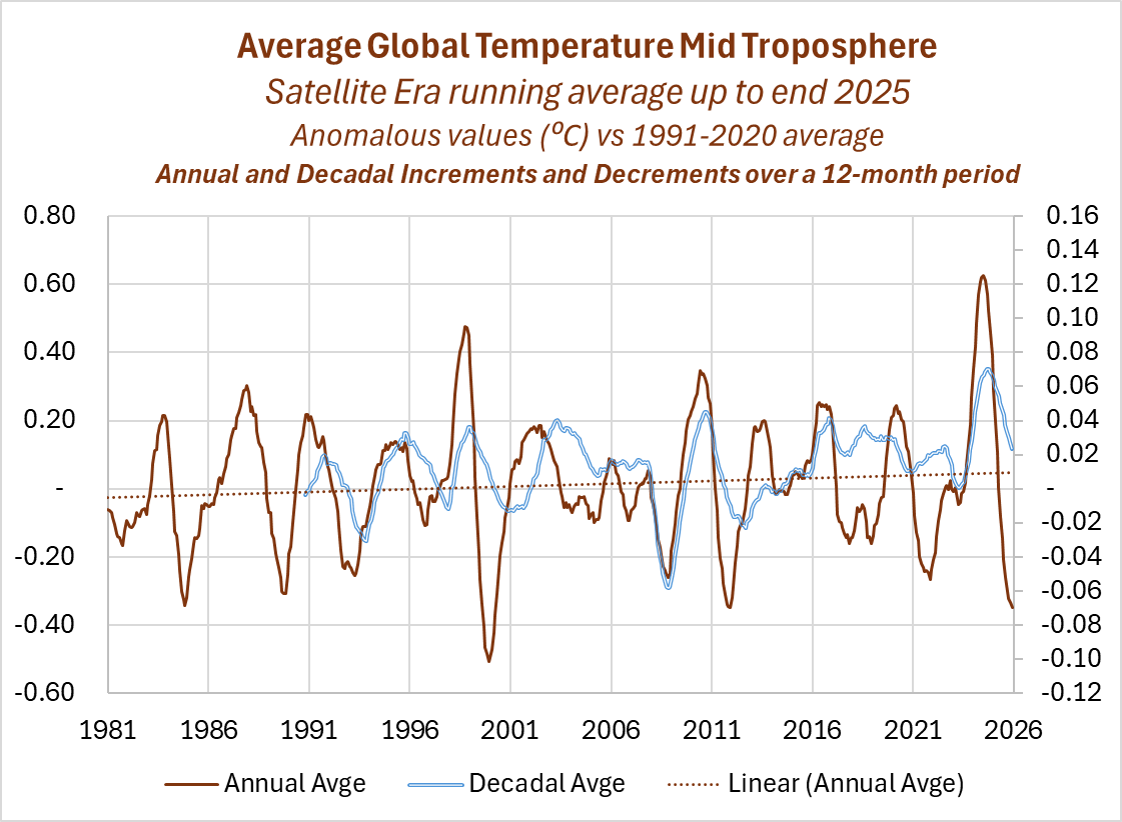
The graph below shows that the 12-month difference between annual averages has twice, in the last 30 years shot up - like the Lower Troposphere.
The first was to around the hot month of April 1998 (+0.59⁰C) as the Kyoto Protocol and the second to the recent record-breaking April 2024 (+0.86⁰C).
The 1998 peak year was an exception in what for the 27-year period (1981 to 2008) a period of falling 12-month difference peaks. It was followed the sharpest cooling (over 12-months) event in the last 45 years.
Unlike for the Lower Troposphere, peaks (of 12-month differencess in annual averages) seem to average around +0.3⁰C and dips to -0.3⁰C.
For over a years the 12-month difference in annual average has been on a falling trend to below the 'average' dip of -0.3⁰C.
Decadal rises and falls (plotted of the Right Hand Scale) tend say more about the modern warm period than is evident in annual averages.