Addendum One Carbon Dioxide
The contribution from carbon dioxide to the total Greenhouse effect, as determined by the Cardinal Model is
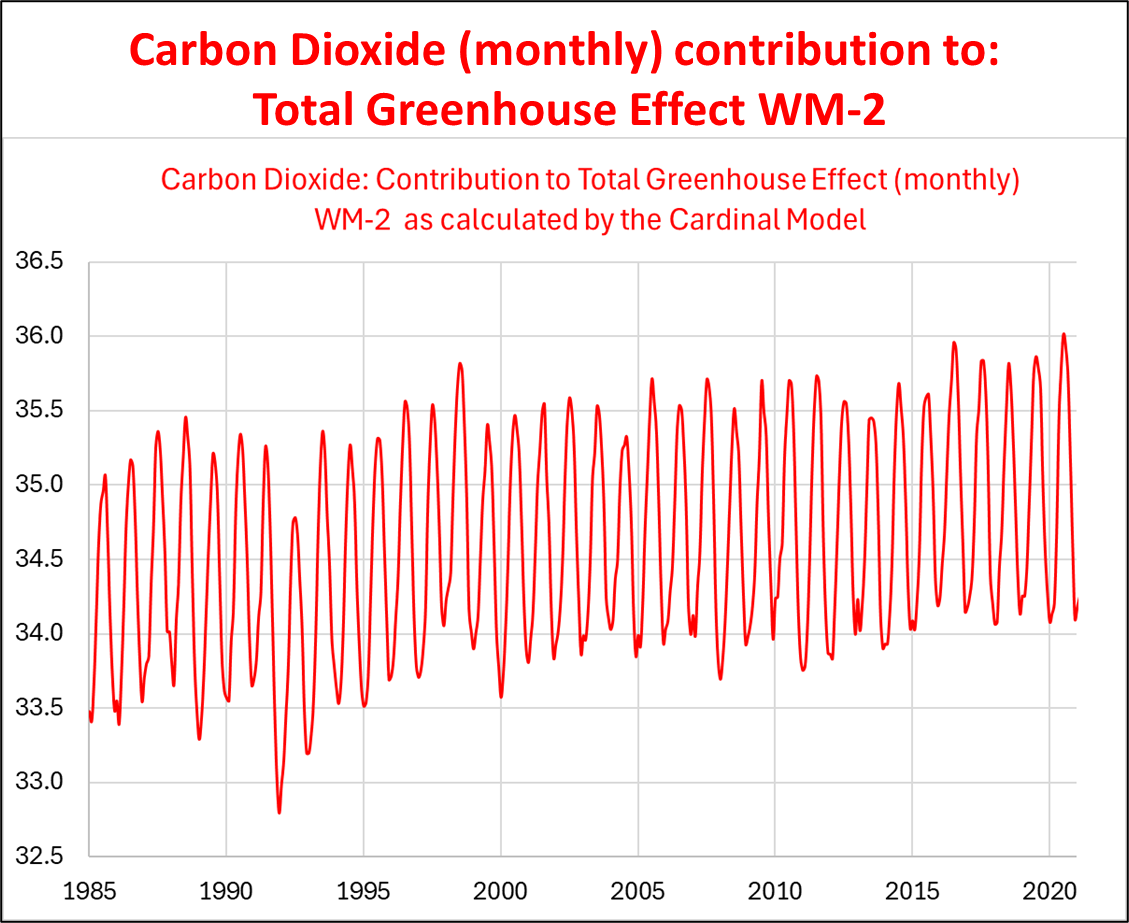
Most of the variability observed comes from changes in temperatures (predominantly of the lower Troposphere and lower Stratosphere).
In the case of carbon dioxide, the effective emission altitude for the saturation zone is the lower Stratosphere. This is the altitude where temperature decline flattens out and thermodynamic considerations stop further Greenhouse gas absorption of CO2 which still has sufficient concentration to support transmission.
In reality, the lower Stratosphere temperature profile is not completely flat and some inhomogeneities allow regions of absorption and emission which are assumed by the Cardinal model to be represented by an average parameter.
The changes of temperature (lower Troposphere and lower Stratosphere) affect the change in Greenhouse Effect due to all CO2 in the atmosphere - particularly the concentrations existing in pre-industrial times..
Almost all the variation in Greenhouse absorption by CO2 comes from the effect of varying temperatures in the saturation zone which is essentially unchanged (in terms of frequency range) from pre-industrial times.
By looking at annual averages (thereby averaging out seasonal effects) and adjusting for temperature variations, the progression of carbon dioxide’s contribution to the total Greenhouse effect may be plotted against CO2 concentration.
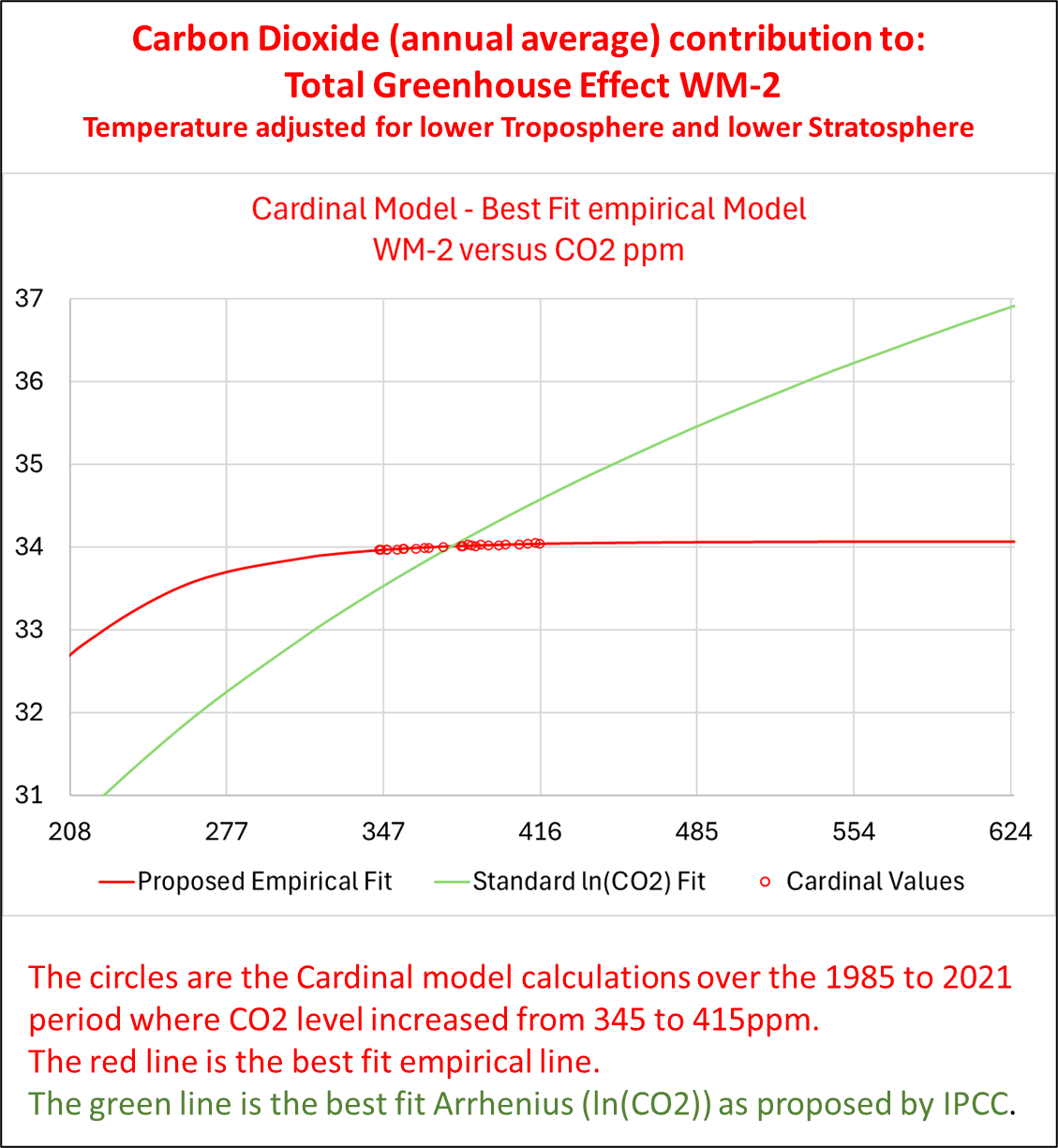
The green line is of the form proposed by Arrhenius which is the form proposed by Anointed Modellers. The green line which best fits the Cardinal model calculations (the red circles on the above graph) is CO2 WM-2 = 5.7 * ln(CO2 ppm).
This falls somewhere between the examples shown in Note 14 of 'The Greenhouse Effect - Technical References and Backup'.
The current IPCC (per their AR6 report) favours a ‘central’ factor of 5.35 for the range of theoretically determined factors used in the Arrhenus form equations of climate modelling.
The red line follows an empirical determined [tanh] relationship:
- Greenhouse effect = a * tanh(b times CO2 concentration in ppm)
- Where: a = 34 and b = 0.009
Note hyperbolic tangent [tanh] is a mathematical function that describes various physical processes involving radiation interaction with matter. This is further discussed in addendum three.
Note: the red line shown above is a best-fit empirical relationship and the parameter values giving the best-fit are not underpinned by theoretical calculations. This argues that the relationship which fits the ‘real world’, although determined empirically, is superior to the theoretical calculation resulting from the circular reasoning of the Anointed modelers.
The value for ‘doubling’ from 277 to 554 ppm is 0.366 WM-2 derived from this empirical curve. The increment from tripling to 831 ppm is minimal as the ‘flat’ part of the [tanh] curve has been reached.
The Arrhenius ‘doubling’ from 277 to 554 ppm is 3.97 WM-2. The increment from ‘tripling’ is a further 2.32 WM-2.
Higher altitude Carbon Dioxide emissions
The emissions from high altitude carbon dioxide from the warming zone of the mid to upper Stratosphere may, arguably, be increased by the increased concentration since pre-industrial times.
As these emissions predominantly come from the main absorption/emission peaks where effective density (number density times absorption cross-section) is sufficiently boosted they may be expected to follow a steeper part of the [tanh] curve than is observed in the Troposphere.
But this 'steeper' effect is a cooling effect as a result of more infrared radiation being emitted to outer space.
Arguably, if the effect were appreciable, it would reduce the contribution to the total greenhouse effect as CO2 concentrations increase - i.e. increased CO2 levels cause Global Cooling.
Attempts to find empirical parameters modelling this expected effect failed to improve the fit (by variance minimisation) of the Cardinal Model so I conclude that this 'Global Cooling' effect is insufficient at CO2 concentrations of 300-400ppm to register anything other that a damping effect on the Tropospheric warming effect.
But I could argue that as the Stratospheric Cooling is on a steeper part of the [tanh] curve compared to Tropospheric Warming, at significantly higher CO2 concentrations Cooling might begin to swamp Warming!
I won't live for another 80 years to observe if this 'swamping' hypothesis is verified by observation.
But it would be a real turn-up for the books if de-carbonising policies actually cause extra warming!