The estimate is derived from the simple equation: Total Greenhouse Effect = Emissions from the Earth’s surface less observed emissions to space.
Emissions from the Earth's Surface
Emissions from the Earth’s surface are estimated using Wien’s law (which is a fourth power law: E = a*T^4 where a is a constant).
Two adjustments need to be made to the value of parameter ‘a’ to fit the real world:
-
Most temperatures are reported as anomalous values against period averages (e.g. Satellite temperatures are reported against 1991-2020 averages) but Wien’s law is non-linear so the effect of ‘seasonality’ must be added back.
-
Because the temperatures making up the Global average are a wide range, a further correction must be made for how this non-linearity affects the estimate of emissions. The calculation is expressed as watts per square metre (WM-2) for the whole of Earth’s surface area.
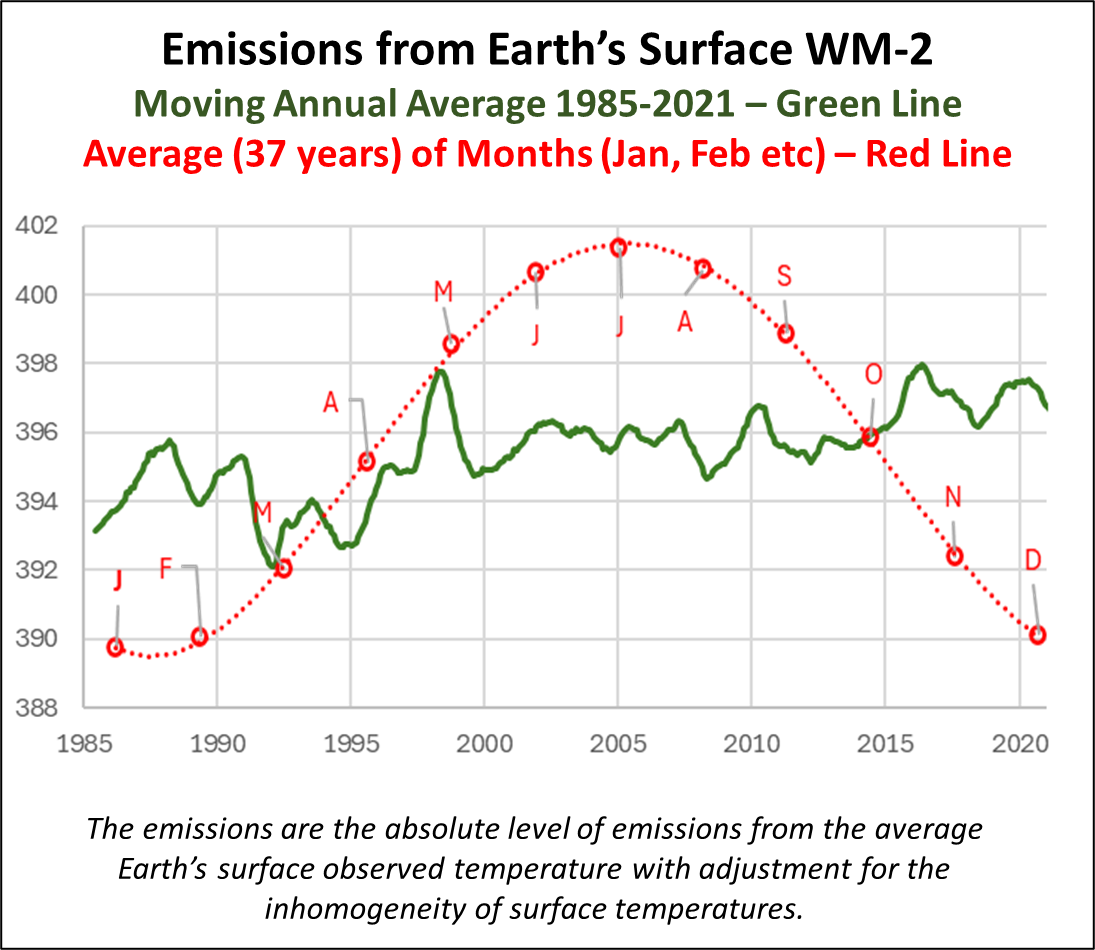
The red line of the graphic is the average of 37 years of monthly data and shows that in July emissions are higher than January. This is the result of land heating up more quickly than ocean and the Northern hemisphere having more land than the Southern hemisphere so emissions from the surface of the Earth are greater during Northern hemisphere summer than Southern hemisphere summer.
The green line is the moving average annual average that smooths out the seasonal effect. The 37-year range of annual averages moves within a range of 6 WM-2 whereas the seasonal range is nearly double this at 12WM-2.
Emissions from the TOA (top-of-the-atmosphere) to space
The second step in this first phase, is to subtract the observed emissions from the top-of-the-atmosphere (TOA) from this estimate of surface emissions. The TOA estimates from satellite measurements of infrared radiation to space available to me cover the period 1985 to March 2022.
Total Greenhouse Effect
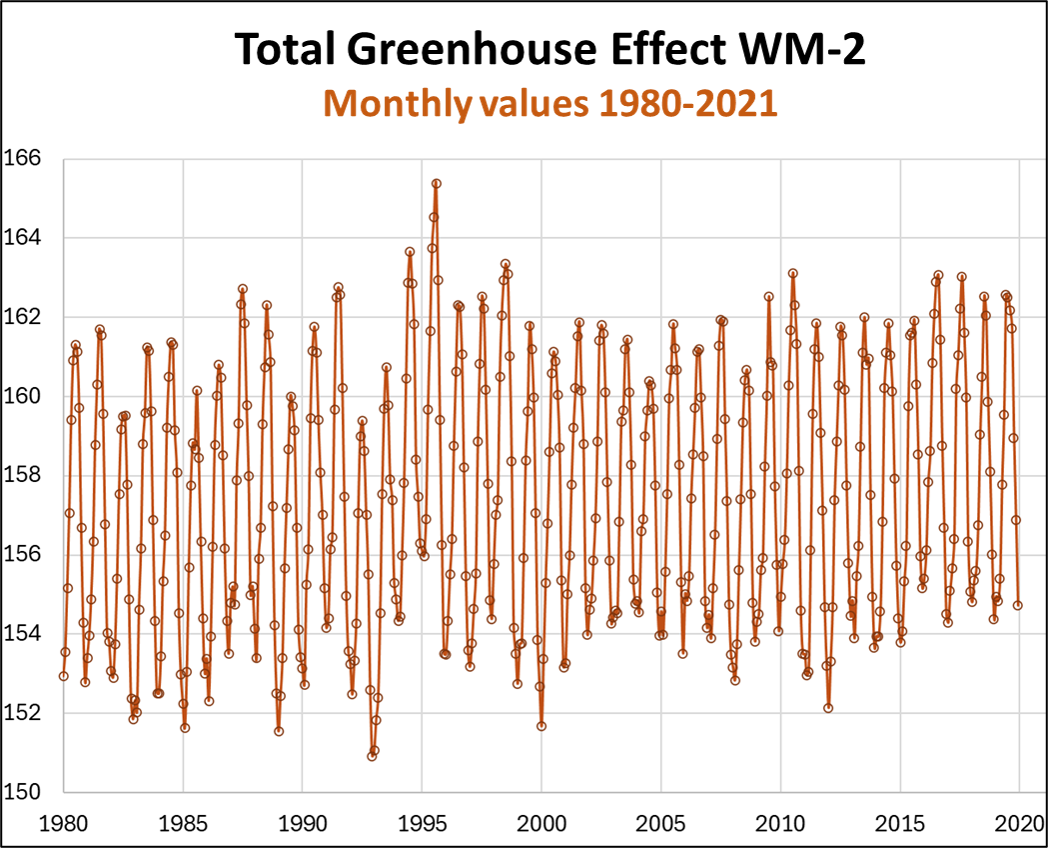
Therefore, the Cardinal model has 447 monthly estimates for the total Greenhouse effect.
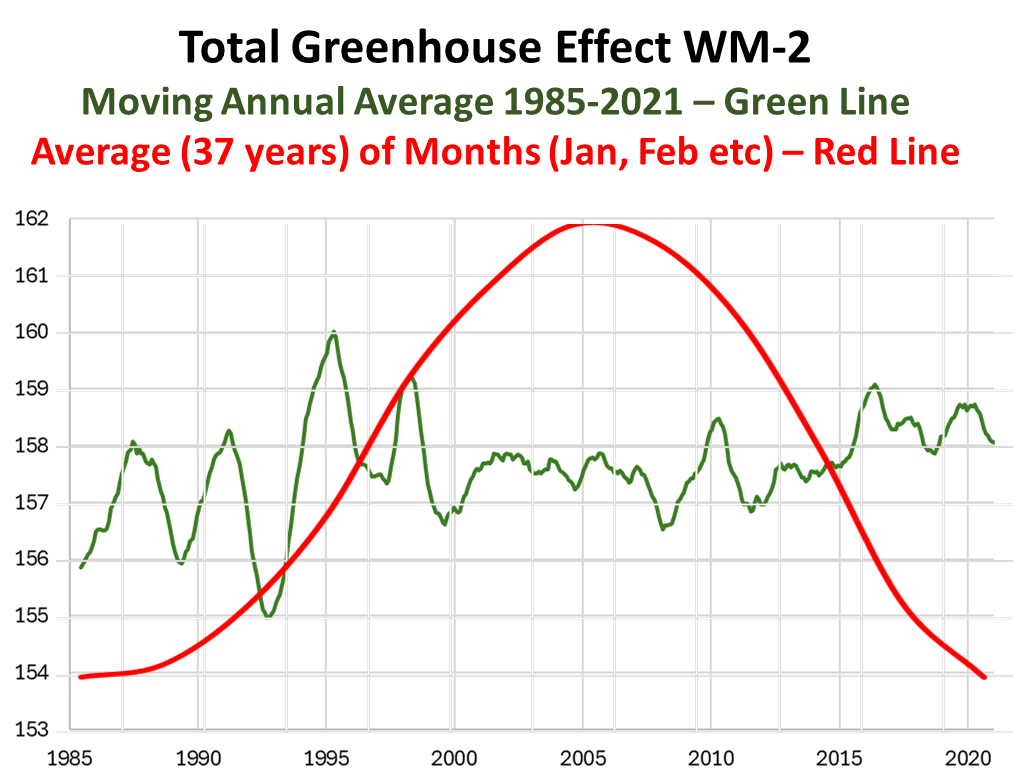
The red line of the graphic is the average of 37 years of monthly data and shows that in July emissions are higher than January (as for total surface emisssions)
The green line is the moving average annual average that smooths out the seasonal effect. The 37-year range of annual averages moves within a range of 5 WM-2 whereas the seasonal range is nearly double this at 8WM-2.
The plot of (the 447 monthly estimates) of total Greenhouse effect is shown below.
The Challenge to the modeller
The challenge of the empirical parameter Cardinal Model is to fit the model calculations to this profile.