Observations and Conclusions
Summary of Conclusions:
Answering the question "Are Anthropogenic emissions causing runaway Global Warming?", the answer from observations is a resounding 'NO!'
The increase in atmospheric levels of CO2, CH4, N2O and O3 since 1850 (to 2025) is largely attributed to Anthropogenic causes and has contributed to a rise in average global surface temperature of +0.25⁰C at most - probably much less.
Further increases, even to a CO2 double-1850 level will add less than 0.1⁰C
Why is this such a definate 'NO!'
Conventional analyses seeking to answer the questions start out with answer 'YES - it's obvious!' and apply circular reasoning to show the positive answer is correct.
Their logic is built on major scientific flaws:
- greenhouse gas absorption is asserted to follow an Arrhenius [ln] form. Observational correlation does not support this assertion and rather supports a hyperbolic tangent [tanh] response where saturation effect is more accurately represented
- evidence for the alleged 'sensitivity' of climate to CO2 is missing - the heavily-criticised 'feedbacks' hypothesis deserves the criticism - it's another mechanism of the circular logic of groupthink
- altitudinal temperature profile variations acting on 1850 levels of greenhouse gases explains far more variability than a simple [tanh] relationship (or [ln] for that matter). In the circulat groupthink logic these variations are erroneously ascribed to be exclusively caused by increases since 1850.
Can we isolate trends due to other factors than Anthropogenic emission? - the answer is 'YES'
The many 'good and best fit' cases of the ‘Emissions-Temp Model’ cannot explain the last 10% of observed temperature variance. There are always unexplained 'residuals'.
These 'residuals' exhibit long-term trends with clear break-points.
Since 1850 there have been two extended periods of falling temperatures: 1879 to 1918 and 1946 to 1976.
The residuals indicate a falling temperature trend of about - 0.06⁰C per decade - for the 69 years about -0.4⁰C fall in total.
There have also been three shorter periods of increasing temperatures:
- 1918 to 1946 (28 years) a rising trend of about - 0.03⁰C per decade - about +0.08⁰C in total
- 1976 to 1993 (18 years) a rising trend of about - 0.13⁰C per decade - about +0.2⁰C in total
- and since 2012.as of 2025 we are in a rising temperature period that has lasted for 13 years - a rising trend of about + 0.08⁰C per decade - about +0.1⁰C in total These cannot be explained by variations in greenhouse gas concentrations as these have already been taken out.
Can we explain these extended periods of rising and falling temperature trends?
The short answer is 'No'.
These trends have nothing to do with Anthropogenic emissions caused by burning fossil fuels but there may be other Anthropogenic factors at play. The most likely being radical land-use change due to agricuture.
Natural factors related to the sun and orbital changes affecting direct surface heating through cloud cover may have something to do with it.
Longer term changes to ocean currents from ice melting/re-freezing as expected at this stage of an interglacial and, just possibly, the longer-term influence of tectonic movements - mainly on ocean currents.
Climate is such a complex, random and non-linear group of systems that, to date, defies accurate modelling.
OBSERVATIONS OF RESIDUALS
The ‘Only’ and the ‘Combined’ cases all show a similar general form.
The plot, below, shows the residuals from the three ‘only’ studies.
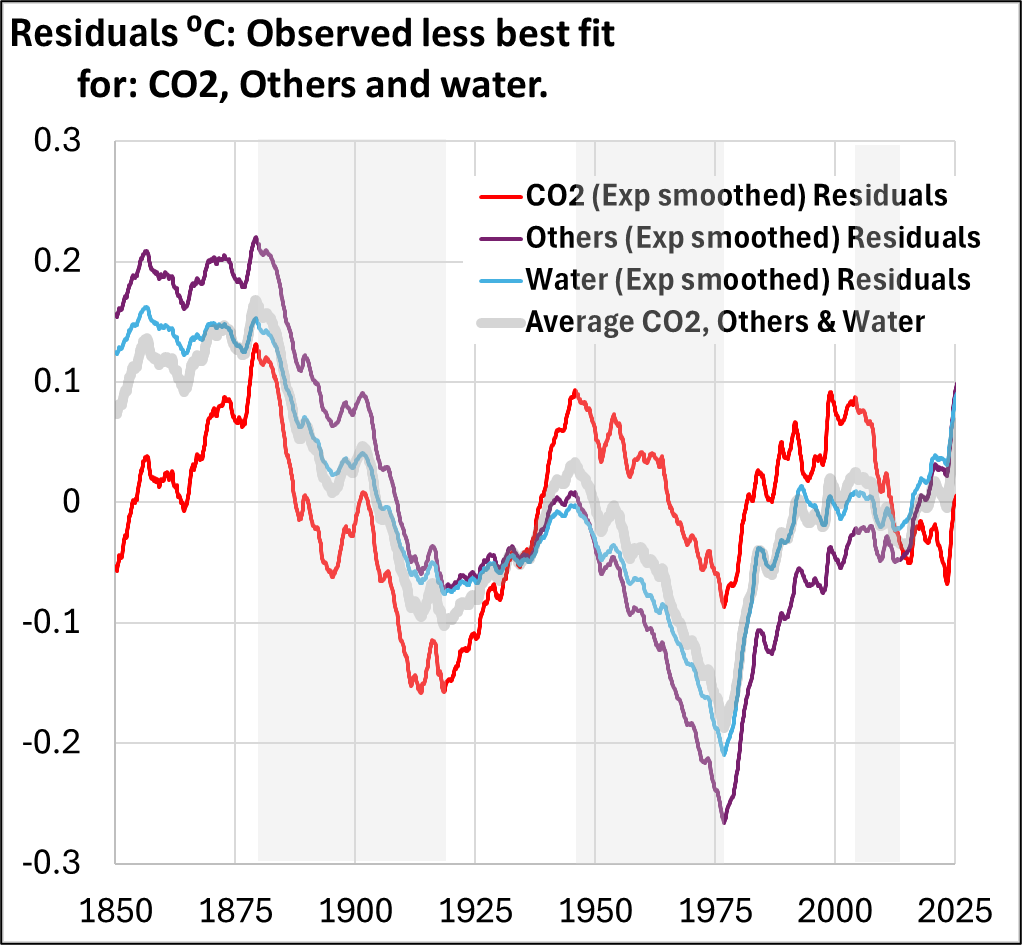
This is strong evidence that other factors are at play in addition to increases in greenhouse gas levels.
The graph below considers the period since 2000 in more detail with the exponential smoothing factor increased from 0.01 to 0.05.
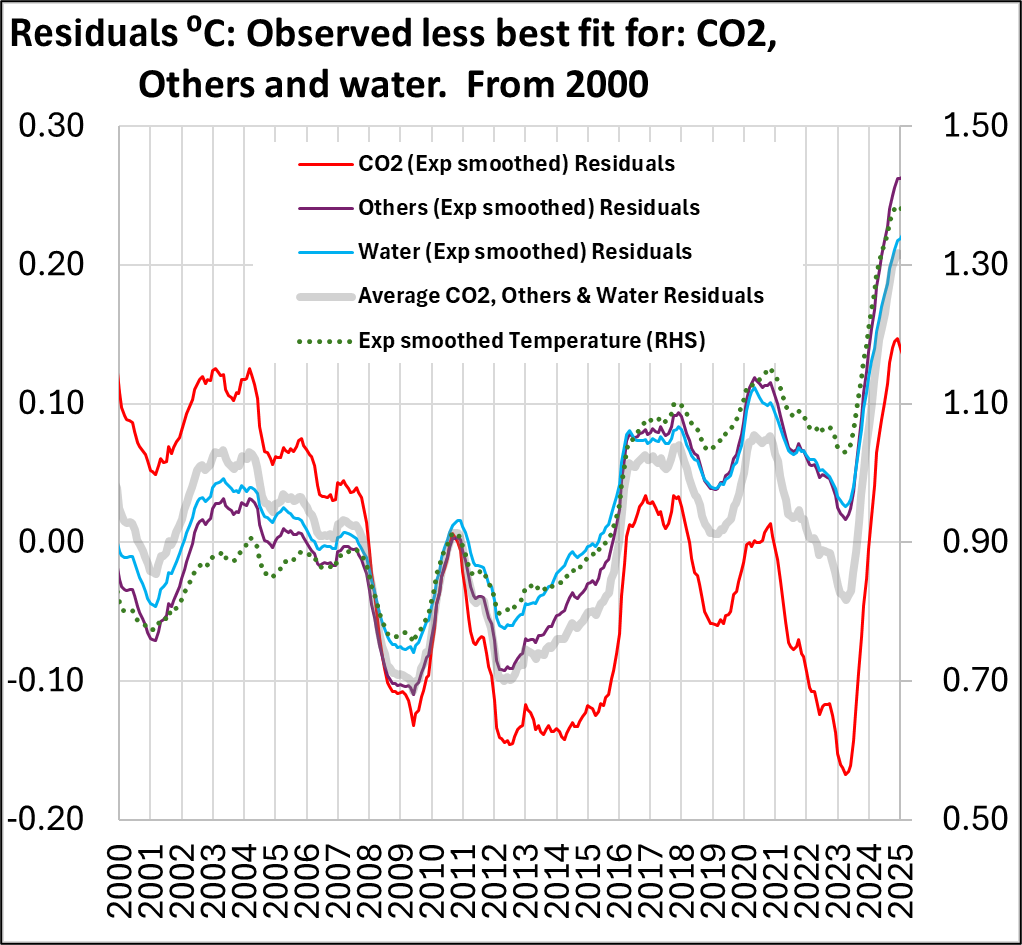
The observed anomalous global average temperature is shown with the same smoothing factor. It is plotted on the right-hand scale which is double the range of the left-hand scale.
A facile interpretation of the above is that changes in the greenhouse effect due to a combination of concentration and atmospheric temperature profiles explain only half the observed temperature fluctuations as the residuals are plotted on a 0.5⁰C scale while temperature is on a 1.0⁰C scale.
For all cases run, the profile of the residuals curve remains similar – particularly with regard to the trend break points.
The ‘Combined’ model case is used to highlight these very definite break points:
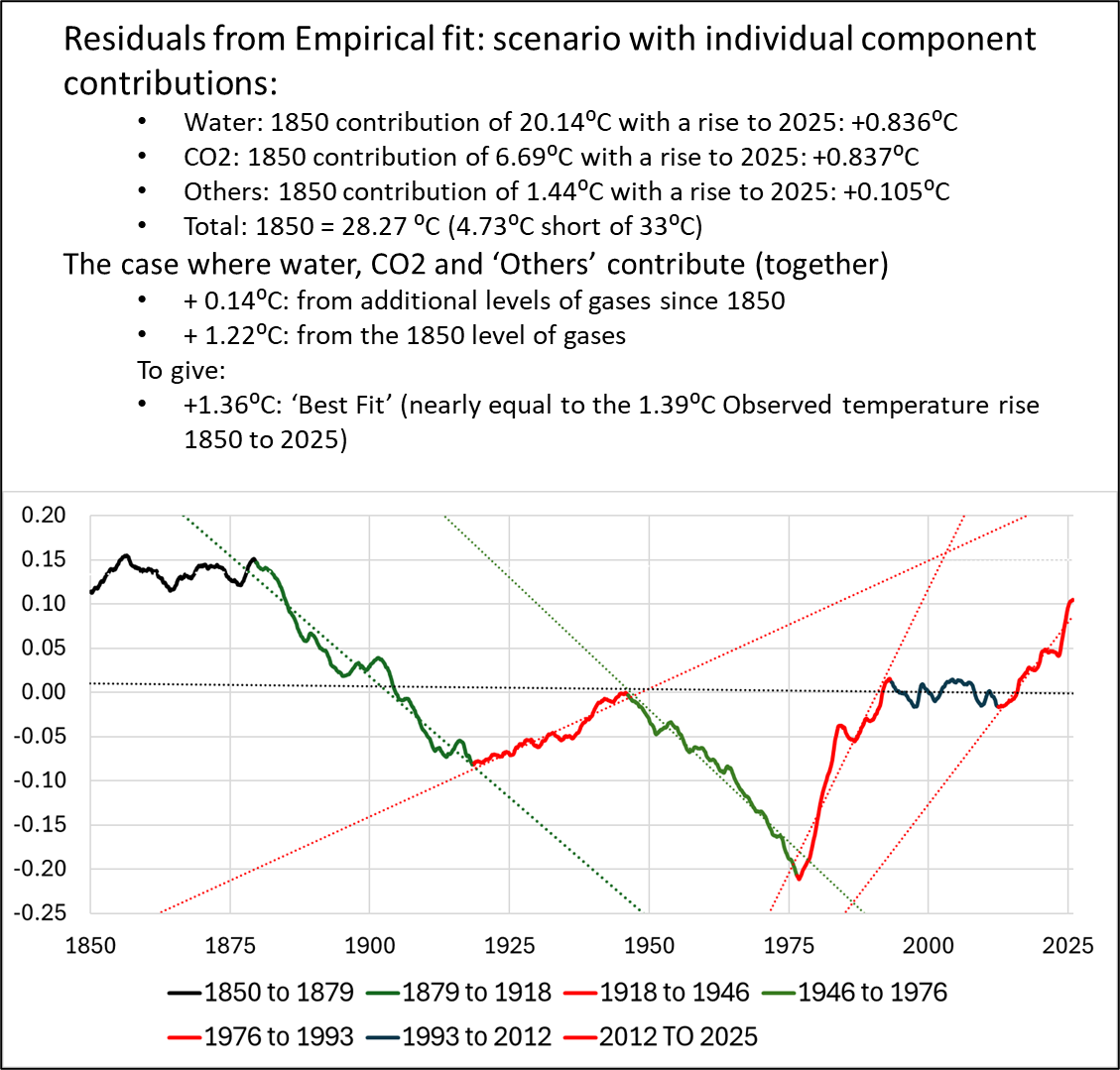
As the element of temperature variations due to variations in concentration of gases has been accounted for – the curve of the residuals cannot, in any way, be explained by anthropogenic emissions.
There are two ‘neutral’ periods of 1850-1879 and 1993-2012 when the trend was neither up nor down.
There have been two extended periods of cooling trend (69 years in total):
- 1879 to 1918: a 39-year period of cooling and
- 1946 to 1976: a 30-year period of cooling.
The second cooling period covers a time when CO2 rose from 312ppm to 330pm.
This cooling period also coincides with my early life and a time when our biggest climate fear was that we were slipping into another ice age.
See further [what is Climate Change?](https://oomeen.com/ what-is-climate-change/).
From 1976 a 17-year period of a rapid rising trend began.
Despite the 'coincidence' noted by Hansen and Bolin, this has nothing to do with changing atmospheric concentrations of greenhouse gases as they are already factored in to the analysis so it must be caused by ‘other’ factors either natural or anthropogenically aggravated.
1976 to 1993 was the period that saw the birth of the Climate Change belief system: ‘The world is uncontrollably warming due to us burning fossil fuels!’
This was foisted on a community primed by eco-socialist beliefs – as covered further in the ‘What is Climate Change?’ pages.
It was readily accepted by left-leaning elites that the coincidence of warming must be caused by increased CO2 although this has never been scientifically proved.
This 17-year period was followed by a 19-year period (to 2012/6) of ‘very little happening’ - a 'flat' period.
But the ‘Global Warming’ belief system was so imprinted into the DNA of politicians and scientists during the 17-year period from 1976 that alarmism continued.
Global Warming morphed into Climate Change and by the end of this ‘flat’ period people were beginning to talk of the ‘Climate Emergency’.
It became a tradition during this ‘flat’ period to report every hot day, fire, flood and hurricane as duee to ‘Climate Change’. The popular (and sometimes the scientific) press love disaster stories – particularly when they can blame someone or something that can be demonised.
From 2012 we have experienced, for 13 years, another warming period – not quite as steep as the 1976-1993 warming period.
Hysteria has reigned since 2012.
‘The world is boiling!’ and ‘The climate is breaking down!’ have become some of the cries commonly heard.
Alarmist predictions abound that are quite similar to those predictions made over 20 years ago following the 'watershed' year of 1976. None of those old predictions materialised.
What is worse are the policies developed during the ‘flat’ 1993-2012 period to counteract this fantasy menace.
These policies, typified by ‘Net Zero’ are now being foisted on ‘the masses’ destroying jobs, energy and food security and the economy in general.
The proponents of these insane policies lap up every extreme weather event and energy-security threat to renew their baseless alarming exhortation to stop burning fossil fuels.
As the above (& other) analysis proves, the current warming is definitely not linked to anthropogenic emissions augmenting greenhouse gas concentrations..
It is to the great shame of most climate scientists (but not all) that environment, biodiversity and climate researchers look little further than ‘CO2’s rising!’ to explain the direction they point (and sometimes wag) the finger-of-blame.
That the Earth is currently experiencing a warming phase is beyond doubt.
But to blame it on CO2 is illogical, intellectual laziness.
The Earth’s climate is immensely complex so we may never understand why it is currently warming.
But if we don’t make the effort to try and instead fall back on the ‘Anthropogenic emissions must be to blame’ we will always end up with inappropriate, worthless and harmful policies to ‘save the planet!’.
WILL A RISE OF GREENHOUSE GASES INDUCE CLIMATE BREAKDOWN?
During this ‘Emissions-Temp Model’ analysis very many different cases have been looked at.
Some of the conclusions we can draw from these cases include:
- There is no model linking global average temperature (anomalous) variations with atmospheric levels of greenhouse gases that explains more than 90% of the variability in temperature observations
- Water may be responsible for large variations in the total greenhouse effect and hence the direct heating of the Earth’s surface through humidity and cloud cover variations, but this is impossible to model.
- CO2, CH4, N2O, O3 and other greenhouse gases can be correlated with surface temperature – but so imperfectly that causation either way can only be hinted at.
- The hyperbolic tangent [tanh] form of models linking enhanced atmospheric concentrations of greenhouse gases with surface temperature are superior to Arrhenius [ln] form models.
-
The [tanh] models treat ‘saturation’ differently to Arrhenius models. Absorption of radiation (the greenhouse effect) tails off as concentrations increase (i.e. doubling of CO2 from 285ppm to 570ppm does not double the greenhouse effect).
Arrhenius models treat this fall off as logarithmic while [tanh] models show a more ‘flattening’ behaviour.
That [tanh] models are significantly better fits to observations than Arrhenius [ln] models proving they are a much better representation of what’s going on.
There may be even better forms of models, but I have not detected what they might be.
There are several analogous ‘saturation’ phenomena which follow a [tanh] form of relationship. For example: in velocity addition in Special Relativity, spin alignment in Statistical Mechanics, neuron firing in Neural Signal Processing, certain velocity profiles in Fluid Dynamics.
This section, therefore, will concentrate on what [tanh] models tell us about the link from enhanced greenhouse gas concentrations to observed temperature variations.
This link, it must be stressed, is indirect.
Enhanced greenhouse absorption brought about by the presence of increased levels of atmospheric greenhouse gases warms the atmosphere and the transmission of this warming to the Earth’s surface is through complex, non-linear thermodynamic effects.
It may even be that surface warming leads to increased levels of atmospheric greenhouse gases. The correlation would be detected in the same way but the direction of causation is not revealed.
How much does CO2 appear to contribute?
Surface temperature variation linked to any particular gas is affected by three factors:
- Contribution to greenhouse effect of existing levels of CO2 due to changing altitudinal temperature profile
- Contributions to greenhouse absorption from additional CO2
- Transmission of additional greenhouse warming to the temperature at the Earth’s surface
Not forgetting that another process may be going on:
- Warming surface of the Earth contributes to additional concentrations of greenhouse gases
The Second Model (described earlier) accounts for the first two of the three factors, but the third is a complex, chaotic and non-linear association beyond my modelling skills.
Additionally, there are processes that also affect the Earth’s surface temperature that are not linked directly with the greenhouse effect.
These processes may be anthropogenic in nature such as land-use change but mostly will be linked to natural factors.
The analysis presented here looks at how the variance in observed surface temperatures might be explained by changes in the concentration of atmospheric greenhouse gases.
A series of cases have been evaluated using the Second Model as described above.
The ‘goodness of fit’ of each case is measured by how much the total variance is reduced.
There is always an ‘unexplained’ element so complete reduction (by 100%) of variance was not expected.
The best fits reduced the total variance by 90%.
This variance ‘explanation’ does not imply causation, but it does indicate that a link may exist.
The graphic, below, needs some explanation:
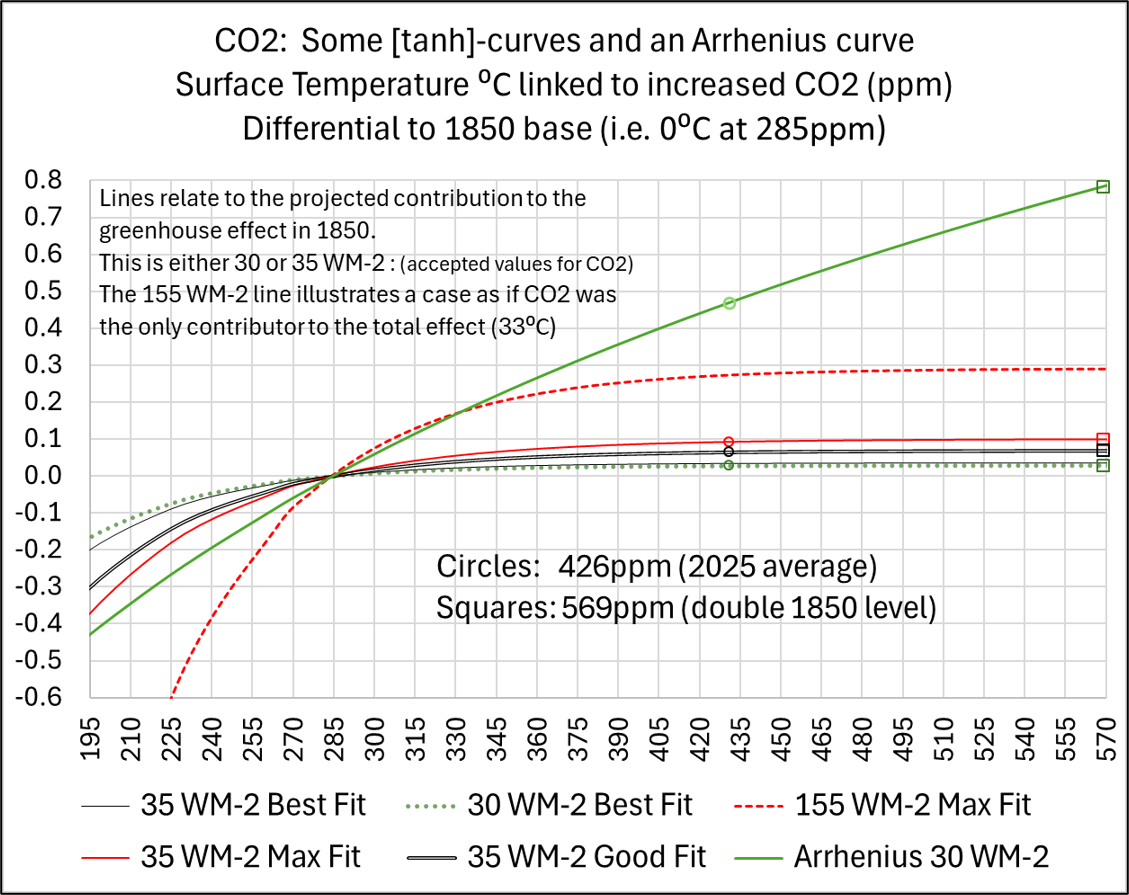
All the lines, with the exception of the green Arrhenius line are derived from variance minimising the ‘Second Model’. This splits the link to temperature variations into two contributions.
The graphs for ‘CO2 Only’ in the individual ‘Some Cases’ section show the split of the two elements of ‘The Second Model’ but in this section we only focus on the contribution coming from increased concentrations of greenhouse gases.
The green Arrhenius 30 WM-2 line is a logarithmic response line that ‘explains’ the 1850 CO2 contribution to temperature of 6.37⁰C (30 WM-2). It forms the basis of the IPCC’s ‘Direct’ calculations and ‘predicts’ a temperature increment from 1850 to 2025 of +0.46⁰C and ‘doubling’ of +0.79⁰C. The IPCC model asserts this is all due to the incremental levels (since 1850) of CO2 in the atmosphere.
Introducing the Arrhenius [ln] relationship into the ‘best fit Combined Models’ causes a drop in variance explained from 90% to nearly 80%.
This implies that the green line Arrhenius [ln] relationship is a poor representation of reality.
The ‘best fit’ lines (dotted 30 line and grey 35 WM-2 line) are the contributions from incremental CO2 that give the maximum variance reduction.
The grey-line 35 WM-2 ‘Good Fit’ is a case where the incremental CO2 contributions was encouraged to be larger – with some loss of goodness of fit.
The red-line 35 WM-2 ‘Max Fit’ represents the case where the incremental CO2 contribution was encouraged to be maximised within a 2% variance fit reduction limit (i.e. from 90% to 88%).
Summarising these cases:
- The contribution to observed temperature increase from increased levels of CO2 to 2025 are most likely less than +0.03⁰C and almost certainly less than +0.10⁰C.
- The further contribution from 2025 to the point of ‘doubling’ is almost certainly less than 0.01⁰C.
This is a most important message as it means that we can go on burning fossil fuels and emitting CO2 into the atmosphere for a very long time with no appreciable impact on climate.
A further – more extreme case - is the red-dotted line shown on the graphic.
This is an attempt to reproduce the standard climate modellers assertion:
‘Climate is sensitive to increased CO2 levels such that by the time ‘doubling’ has occurred the surface temperature will have increased by between 2.5 and 4.0⁰C.’
The red-dotted-line case was constrained to make the [tanh] line to start at -33⁰C at 0 ppm CO2 and pass through zero in 1850 (285 ppm CO2). The Second Model total 1850 to 2025 increase of +1.36⁰C is entirely due to CO2.
The total from this line is not shown – only the portion due to increased CO2 levels since 1850.
This is not a ‘good fit’. Trying to maximise the dotted red line contribution from increased levels of CO2 it could not be ‘made’ to go more than +0.27⁰C with a further +0.02⁰C from doubling.
Although a poorly fitting case, the dotted red line was still a better fit than the green line Arrhenius [ln] fit.
This is even more evidence that the calculations of the Arrhenius model particularly with exaggerated ‘feedbacks’ are entirely invalid.
How much do the ‘Others’ contribute?
A similar investigation (to CO2) was carried out for the ‘Others’.
Expressed in terms of ‘equivalent CO2’, a series of cases have been evaluated as described for CO2 above.
The ‘goodness of fit’ of each case is measured by how much the total variance is reduced and the ‘Others’ exhibited worse fits than for CO2.
The ‘Others’ graphic, below, needs some explanation:
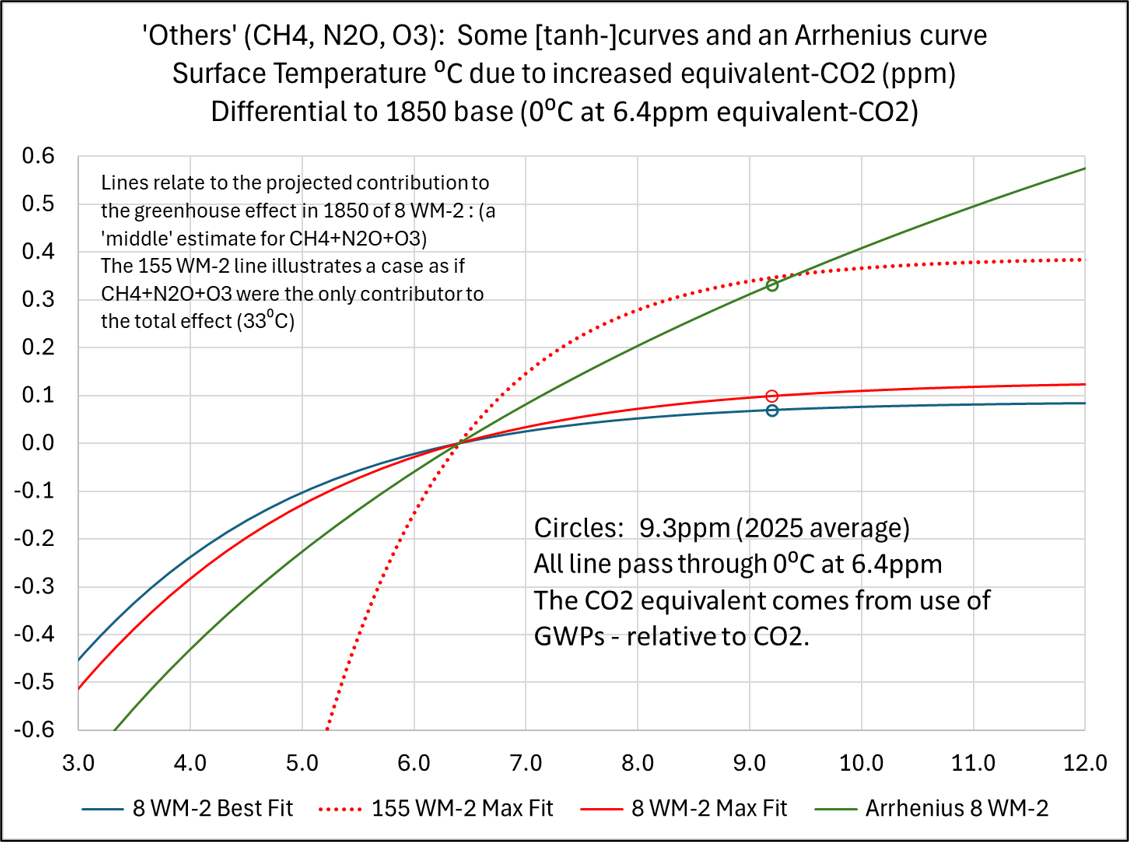
All the lines, with the exception of the green Arrhenius line are derived from variance minimising the ‘Second Model’.
In this section we focus on the contribution coming from increased concentrations of greenhouse gases.
The green Arrhenius 8 WM-2 line is a logarithmic response line that ‘explains’ the 1850 ‘Others’ contribution to temperature of 1.7⁰C (8 WM-2).
Nevertheless, a [ln] form relationship is used in ‘Direct’ calculations and ‘predicts’ a temperature increment to 2025 of +0.34⁰C.
The ‘best fit’ line (8 WM-2) shows the contributions from incremental CO2 that give the most variance reduction.
The 8 WM-2 ‘Max Fit’ represents the case where the incremental ‘Others’ contribution was encouraged to be a maximum - within a 2% variance fit reduction limit.
Summarising these cases:
- The contribution to observed temperature increase from increased levels of ‘Others’ to 2025 are most likely less than +0.07⁰C and almost certainly less than +0.15⁰C.
- The further contribution from increase from 2025 levels will be greater than from CO2 but of the order of 0.01 to 0.05⁰C.
A further, red-dotted line is shown on the graphic which is an attempt to model the assertion: ‘Climate is sensitive to increased ‘Others’ levels such that direct effects are multiplied by a series of ‘feedbacks’.
The case was constrained to show that the whole of the greenhouse effect (155 WM-2) in 1850 is due to ‘Others’ and the 1850 to 2025 increase of +1.36⁰C is entirely due to ‘Others’
This is not a realistic case and is certainly not a ‘good fit’.
The general message is that the ‘Others’ response curve is not as ‘flattened’ as the [tanh] CO2 response curve but at current ‘Others’ concentrations it is beginning flattening out significantly.
Future rises (particularly of CH4) may not hold the same climate-destroying impact as often asserted.
This message will be welcomed by livestock farmers.