What does the Cardinal Model tell us?
The values of the empirical parameters that minimised variance did so that the model calculation matched every estimate of total Greenhouse effect to within 0.003WM-2 or less for each of the 447 months.
The range of total Greenhouse effect is about 14WM-2 (over 1,000 times larger) so this is close to a perfect fit.
Water is the main contributor to the total at 71.2%.
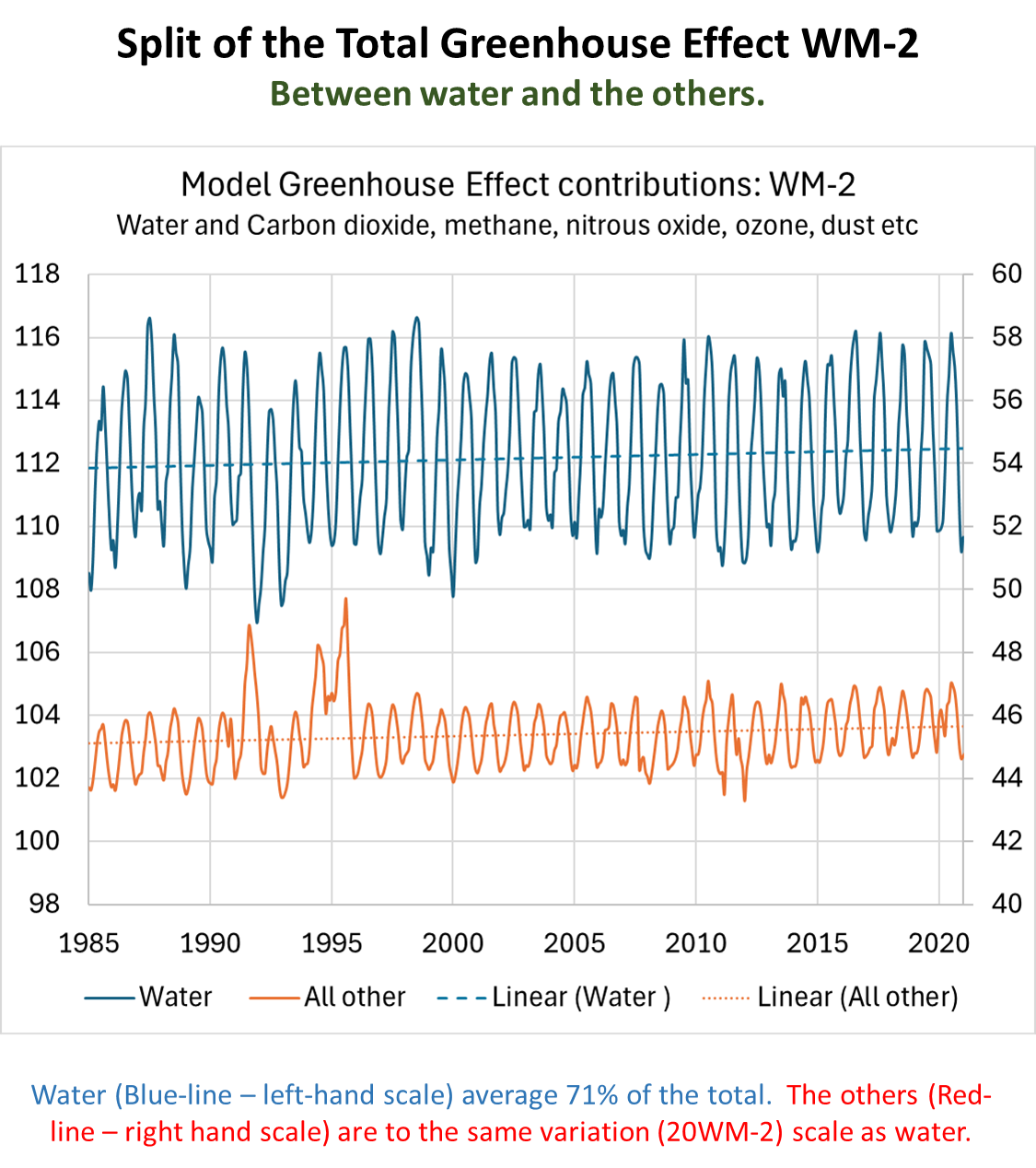
Note that Greenhouse effect warming directly heats the atmosphere of Earth and has only an indirect effect on surface temperatures.
By attributing all enhanced Greenhouse effect to surface warming directly to the Cardinal model output of total greenhouse effect (in WM-2) can be empirically related (using the factor 1⁰C is 4.71WM-2) to surface warming.
This is found to be – on a ‘best fit’ basis – to approximate more to a [tanh] (hyperbolic tangent) curve than a [ln] (logarithmic) curve as proposed by Arrhenius (and asserted by Anointed modellers).
This distinction betweeen logarithmic and hyperbolic tangent is critical in determining what is actually (observationally) going on. This is further discusssed in 'The Greenhouse Effect'.
Only at very low concentrations of any particular Greenhouse gas is there evidence of a steep rise in the contribution of any particular gas to the total.
Once some of the absorption bands reach 'saturation' the steepness of curve begins to flatten out. For CO2 this, theoretically, begins to happen around 5 to 6 ppm. As the Earth has never experienced CO2 levels below ~200ppm this is a very 'theoretical' resulting from analysis of the spectral cross-sectional profile of CO2.
Below ~200ppm, photosynthesising plants hit starvation. Below 250ppm they become stressed.
Pre-industrial CO2 was ~277ppm. Optimal CO2 level for green plant growth is above 1,000ppm. 2025 average ws 420ppm.
By a concentration level of 277ppm, (even below 20 to 50ppm) all the major absorption bands of CO2 have reached saturation and additional atmospheric concentration of CO2 only add to to increased heat absorption by spectral broadening.
The page 'The Greenhouse Effect' considers this 'Broadening and Overlap Zone' further. This is the zone of contention between Anointed modellers and so-called 'Deniers'.
The Cardinal Model avoids this theoretical (acrimoniously Manichaen) debate by only considering what is observed.
For carbon dioxide the 'best fit' curve is of a hyperbolic tangent [tanh] form and not an Arrhenius [ln] form.
This observational fact, alone, should raise doubts about why the obviously inappropriate Arrhenius [ln] equations form is used as the 'stock-in-trade' formula for the climate modelling.
Some Specific results:
-
Carbon Dioxide ‘doubling’: an extra 0.366 WM-2 since pre-industrial times
-
Methane ‘tripling’: 0.094 WM-2 since pre-industrial times
-
Other Greenhouse gas ‘doublings’ <0.311 WM-2 since pre-industrial times
-
Total ‘doubling’/’tripling’: <0.771 WM-2 since pre-industrial times
-
Total from pre-industrial times to 2025: <0.653 WM-2.
-
Total from 2025 to ‘doubling’/’tripling’ ~ 0.118 WM-2.
Converting these to surface warming in degrees centigrade (using the equivalence factor 1⁰C = 4.71 WM-2) gives an estimate of the contribution of all increased concentrations of Greenhouse gases (except water) to surface warming from pre-industrial times to 2025 of 0.14⁰C and to ‘doubling’ (‘tripling in the case of methane) of a further 0.02⁰C from 2025.